Home / Mumbai-guide / Things To Do / Article /
Rediscover Mumbai poet Adil Jussawalla's work through the lens of Jeet Thayil
Updated On: 26 August, 2025 09:09 AM IST | Mumbai | Fiona Fernandez
A new imprint offers a fresh, insightful lens on India’s eclectic literary landscape. It opens with the celebrated poet’s undiscovered gem, Soliloquies, a lost piece of poetry in print for the first time, accompanied by a revelatory interview with poet-novelist, and curator of this imprint, Jeet Thayil



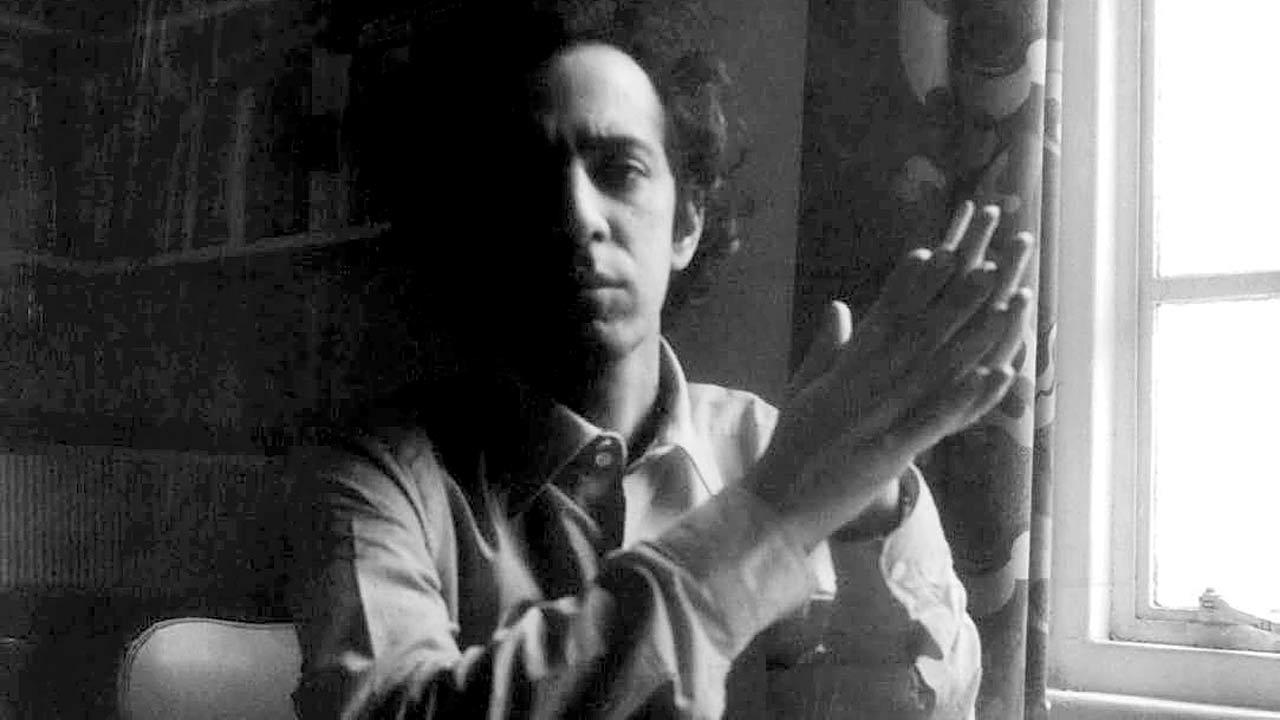
Selfie, circa 1965. PIC COURTESY/ ADIL JUSSAWALLA
There’s a certain enchantment that comes with reading an interview where a celebrated modern-day author-poet is in conversation with a literary legend. It’s intimate, magical and insightful, all at the same time. Soliloquies by Adil Jussawalla is the first title in a series under Thayil Editions (HarperCollins India), a new imprint that is an attempt to consume and discover (or rediscover) the body of work of handpicked talent across India’s literary landscape. Jeet Thayil’s brainchild, the first in the series, kicks off in fine style with a tribute to Mumbai’s literary icon. It includes a rare selection of poems that Jussawalla wrote as part of a play, Jian, when he was barely 18-years-old. The palm-sized book contains his poetry, and a freewheeling interview by Thayil, packaged in pop art-meets-psychedelic design. There are delightful insights into Jussawalla’s childhood, his trysts and conflicts with his academic decisions, his personal life, and his return to the city of his birth.

Adil and Katia in London, 1968/69. PIC COURTESY/VERONIK JUSSAWALLA
The interaction reads less like an interview and more like a conversation. “I was struck by how frank and unpretentious Adil’s replies were to my questions. Some of the topics were personal, topics he has never addressed on record. It’s the viewpoint of a poet looking back on a life well-lived in literature, a poet with nothing to lose and nothing to prove. Throughout the interview, a wicked and self-deprecating sense of humour is in evidence,” reveals Thayil, adding, “For me, for all these reasons, the interview is as valuable as the poetry. It is an overview of a remarkable life, in which history is a constant, and cultural history, a bonus. For Indian poets, of whichever age and language, it holds an important lesson — not in the writing of poetry (which can’t be taught), but in how one can live as a poet.”
Trending Stories
Latest Photos
Latest Videos
Latest Web Stories
ADVERTISEMENT
Mid-Day Fast
ADVERTISEMENT

ADVERTISEMENT