






Home / Mumbai / Mumbai News / Article /
Does NEP really account for visually impaired college students in Mumbai?
Updated On: 11 July, 2025 08:33 AM IST | Mumbai | Aditi Alurkar
The NEP’s new interdisciplinary structure means humanities students might now have to study science subjects like physics or math, while science students could be required to take up additional languages

Listen to this article :
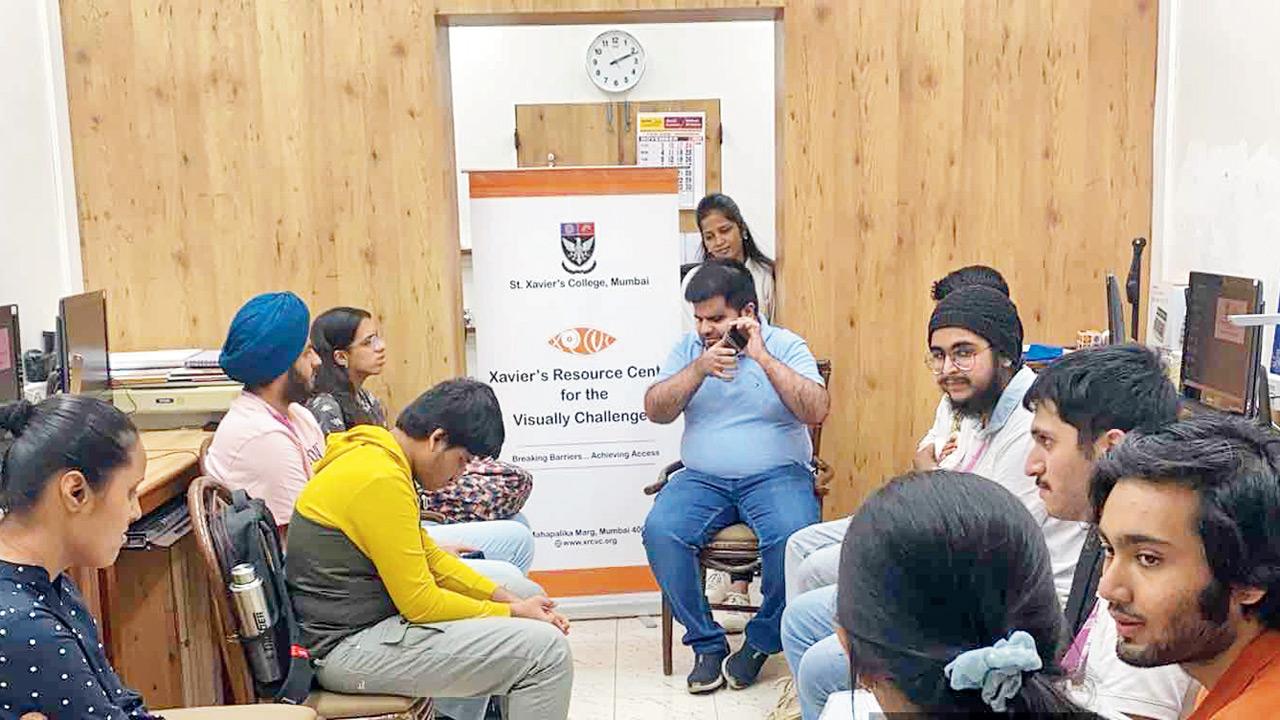
A session underway at XRCVC for the visually challenged. PIC/XRCVC
While the recently implemented National Education Policy (NEP) prioritises inclusivity, students with disabilities still face challenges in city colleges. Introduced in 2020 and rolled out for current undergraduate batches, the NEP dedicates an entire chapter to ‘equitable and inclusive education.’ However, the policy also mandates cross-faculty courses, internships, and research work requirements that may not be practical for all students, according to special education experts. The NEP’s new interdisciplinary structure means humanities students might now have to study science subjects like physics or math, while science students could be required to take up additional languages.
“Without offering alternative subjects, the new structure makes learning tougher for many students,” said Poonam Deokar, lead consultant for inclusive education at the Xavier’s Resource Centre for the Visually Challenged (XRCVC). At St. Xavier’s College, Fort, alternatives like IT and library sciences are available for visually impaired students. The NEP also pushes for research-based credits, written assignments, and online learning — all of which demand accessible content, trained staff, and assistive support, pointed out XRCVC’s Managing Consultant Ketan Kothari.
Students, teachers speak
Trending Stories
Latest Photos
Latest Videos
Latest Web Stories
ADVERTISEMENT
Mid-Day Fast
ADVERTISEMENT

ADVERTISEMENT