When do you ‘know’ a language?
Updated On: 03 December, 2021 07:15 AM IST | Mumbai | Rosalyn D`mello
Except there isn’t a magical point when you know, for certain, that you ‘know’ a language. From the instant you begin to embrace it, allowing it to gestate within you, you already are speaking it





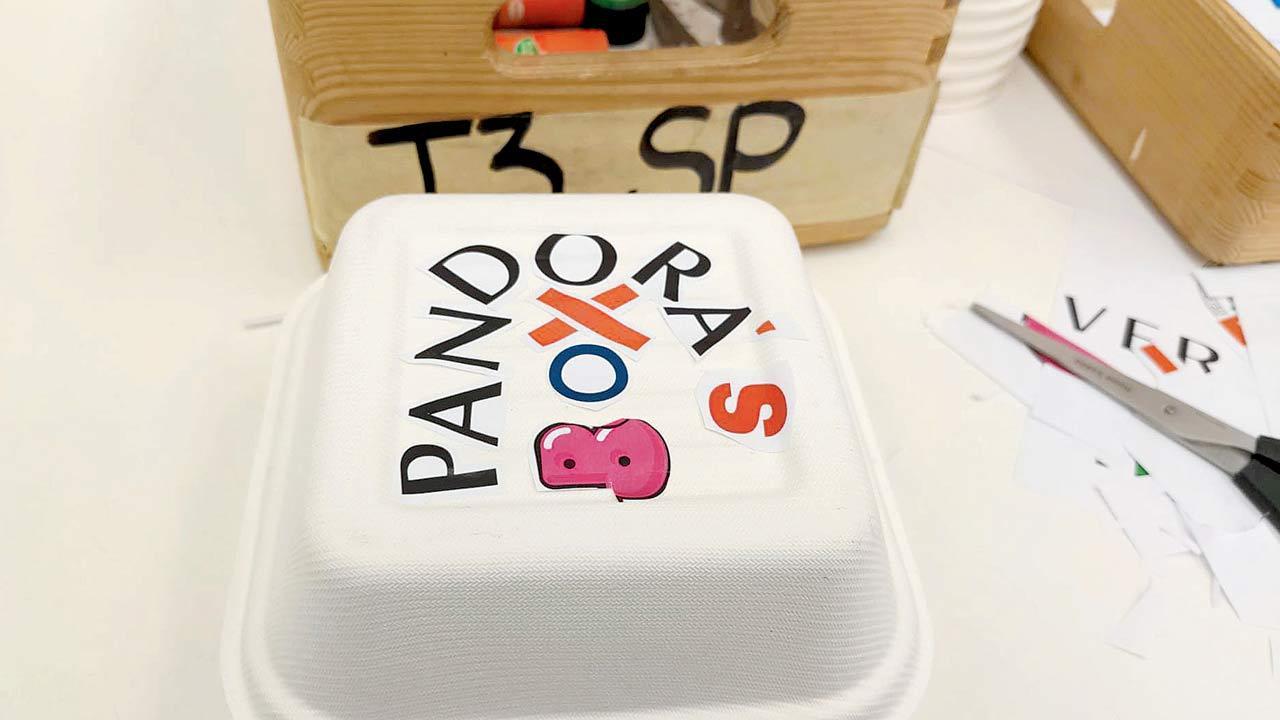
As part of the Italian class, we were asked to create statement lunch boxes, using scissors and a pen and glue, that critique capitalism. Rosalyn D’Mello
 Today’s Italian class took place inside the contemporary arts museum in Bolzano. It was an intriguing situation to be in, considering so much of my professional life involves visits to museums, and I’m often offered guided walkthroughs either by the director or someone directly responsible for the show, like the artist or the curator. Today, instead, our class of five students were greeted by the person in charge of education and outreach. It was amusing because given our beginner level of fluency with the language, we were essentially treated like high school students. It was not a terrible experience. In fact I felt, because it was the complete opposite of what I’m accustomed to, I enjoyed myself tremendously. Walkthroughs for adults and art world professionals are usually conducted in a language that is intensely jargon-filled, with most sentences infused with a deliberate complexity that is always gratuitous in my opinion. The lack of narrative clarity is what tends to distance us from the art we see on display, which is, in any case, a manifestation of artistic subjectivity, therefore inherently subject to opaqueness.
Today was the first time I had to attempt to compose responses to artworks in a language I do not at all feel proficient in. The exhibition currently on display at Museion is called Techno. The poster for the show is supremely ugly—featuring a burning earth with limbs. I had very few expectations. But our initiation began in a corner, on the floor. We were asked to think of words in Italian that we felt described with some adequacy the times we currently inhabit. Our Italian teacher instructed our guide about our level, asking her to speak slowly, which she did. She managed to get us to communicate, using broken or half-remembered words. We had to then express words that related to our personal lives. When she turned to me I felt tongue-tied. I couldn’t remember the word for hope in Italian. It’s La Speranza.
Trending Stories
Latest Photos
Latest Videos
Latest Web Stories
ADVERTISEMENT

Ganeshotsav 2026

ADVERTISEMENT