






Home / Entertainment / Bollywood News / Article /
Bollywood folk talk about working around Censor laws
Updated On: 22 March, 2015 10:24 PM IST | | Asira Tarannum, Shubha Shetty Saha, Bharati Dubey and Ajay Brahmatmaj
<p>In the light of the recent Censor Board issues and the growing gap between the government and the film industry, six outspoken industry folk met to discuss what ails the system and how to redress it</p>

Listen to this article :
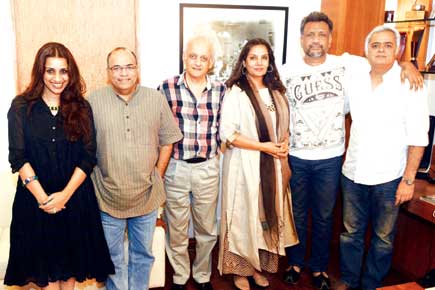
Ashwini Yardi, Chandraprakash Dwivedi, Mukesh Bhatt, Shabana Azmi, Anubhav Sinha and Hansal Mehta
Q. We need to find solutions to the issues which have been pending for long. Is there a communication gap between the members of the Censor Board and the producers?
Shabana Azmi: Let's look at the larger picture. In a democracy, there is freedom of expression and it has to be safeguarded as said in Article 19 of the Indian Constitution, but there is no such thing as absolute freedom. It is done with reasonable restraint even within Article 19. It, itself, celebrates the fact that all creative artistes within them have some kind of regulation which says this is not recommended for kids, etc. Now what we are looking at is basically freedom of expression rather than film certification. Three to four years ago, I had stated that we have to stop calling it the Censor Board because that suggests implicitly that your job is to censor. It is a film certification board as their job is to certify according to appropriate ages — that is their business. When you keep referring it as the Censor Board, then you keep thinking that it is my mandate and find objectionable stuff. What we have adopted as the system of film certification needs to be revisited. We are following the UK system of film certification. It means that there is one chairperson and then there are 30-odd members or how many ever members you want who are selected. They are supposed to be reasonable people from society whom you respect. There all kinds of drama people and litterateurs and not necessarily people belonging to the film fraternity — that I think is basically the fault. What happens is when my party comes into power, Ichoose in that board people who share my political dispensation, which essentially means that every five years we are subjecting the morality of the country to political dispensation of their rule. It is not important which party it is, but this is unacceptable for one billion people to be subject to the political dispensation of the day and the morality being judged. This is the problem. Now what can we do? I think the time is now ripe that we closely look at what USA is doing. They have a self-regulatory body that has people within the film industry and also sociologists. The business of cinema is the business of images and we know pictures speak at subliminal levels much more than any amount of words. For instance, I constantly believe that violence around the corner is suggestive and violence is far more effective than graphic violence. Why do we not start a dialogue to have a self-regulatory body from within the industry and outside? I know it is not easy nor will it happen the next day. I have been a member of the Broadcasting Content Complaint Council (BCCC) since the last three years and it has a liberal group of members. When things come to us, whether it is from the ministry or from the public, we call them and talk to them. We tell them you will shift it to the graveyard hour because it is not appropriate. So you either shift or don't show it. There has been 98 per cent compliance because people know that if it reaches the ministry they will be in trouble. My suggestion would be to overhaul the system. The Justice Mudgal Committee which was set up during the UPA government has done a lot of ground work to revisit the Cinematograph Act. We should look at it carefully. What firm proposal can we give to the ministry? It is we who are directly affected and we need to overhaul the picture as we know better.
Ashwini Yardi, Chandraprakash Dwivedi, Mukesh Bhatt, Shabana Azmi, Anubhav Sinha and Hansal Mehta. Pics/Sayyed Sameer Abedi
Q. The draft of guidelines was apparently ready in 2010, but nothing has moved on that front.
Mukesh Bhatt: As Shabana rightly says, whatever party it is, the tragedy is that the entertainment world is the last on their priority list. We don't exist on their list and are always put on the backburner.
Shabana: But we are safe also because of that. It is said that the government has no job in films, it really should not have. If we let the state start interfering beyond a point, we are doomed.
Anubhav Sinha: I had asked the Secretary in the Ministry of Commerce and Industry at the Federation of Indian Chambers of Commerce and Industry (FICCI) seminar what do you do for us? You call us an industry. Have you ever told a banking sector that you have to invest 200-crore in the entertainment industry?
Shabana: They did, of course, when we got industry status.
Anubhav: What I am saying is that there is a certificate called PG15, which has been pending in parliament for 200 years — PG15 is between A and U/A. Whenever its discussion comes up, people abuse and ask the people to sit. They are not able to sort out their issues, so expecting a PG15 certificate is difficult.
Shabana: You have come up with something important Anubhav, because we have so many people who are members of parliament. Why do we not get all the members and tell them our issues? They are expected to talk about the film industry.
Anubhav: So the first and very important thing we should do is meet all these members and put our issues in front of them. We have never spoken to them about our issues.
Hansal: When this government came into power, Prakash Javadekar, who was the I&B minister then questioned the ministry's existence. He said the I&B ministry should not exist, but why? Doesn't the I&B ministry need the lobbying and representation within the government body? If you are questioning the existence of a Central ministry for I&B, it tells you how important it is in the scheme of things.
Shabana: Why does a film institute need to be under the I&B ministry? It should be in HRD. It should have the same value that any other IIM degree has. What is the meaning of the film institute which is under the government and where they spend more than 20 lakh per student?
Read Next Story
Trending Stories
Latest Photos
Latest Videos
Latest Web Stories
ADVERTISEMENT
Mid-Day Fast
ADVERTISEMENT

ADVERTISEMENT