Home / Entertainment / Bollywood News / Article /
From HRT to high-intensity training, how Mini Mathur is battling perimenopause
Updated On: 23 October, 2024 07:26 AM IST | Mumbai | Sonia Lulla
Among the early industry folk to speak candidly about battling perimenopause, host and anchor Mini Mathur opens up on taking Hormone Replacement Therapy, doubling down on her training intensity, and aspiring to help women live a better life



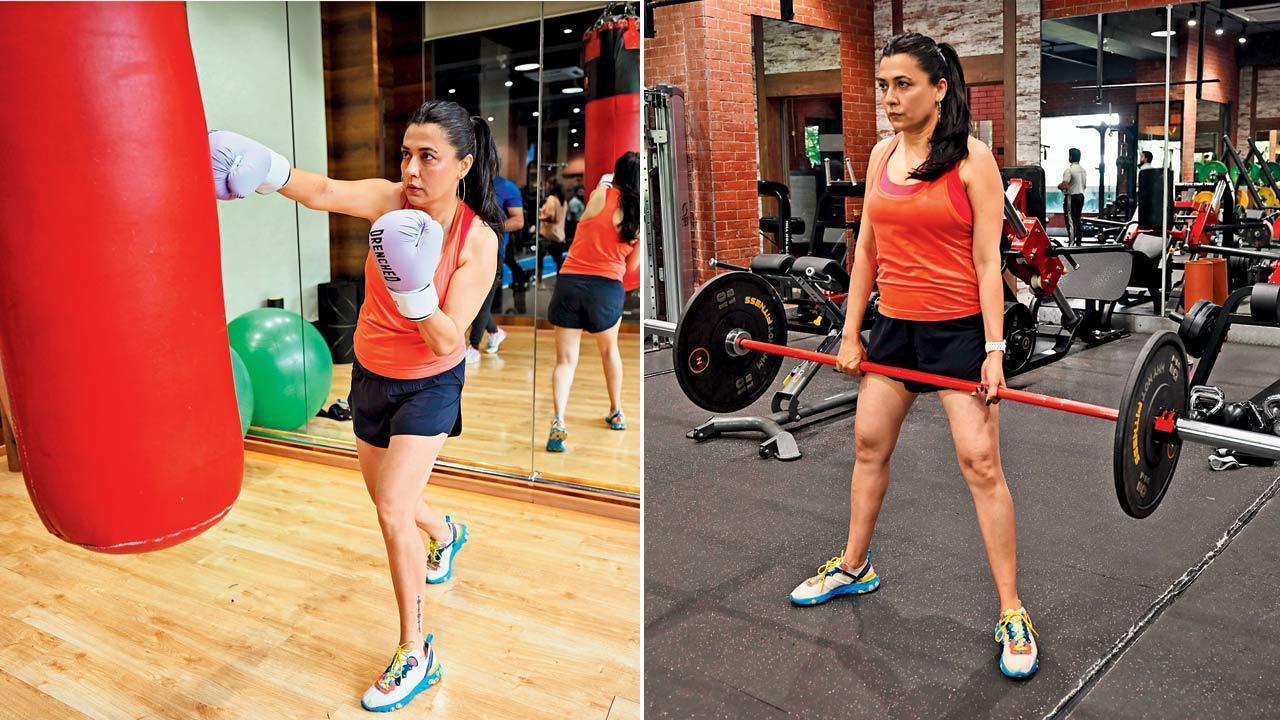
Mini Mathur trains with her trainer Dhiraj Kaskar at Andheri’s Why Not Fitness. Pics/Kirti Surve Parade
Several years before she began to experience the first symptoms of perimenopause, Mini Mathur had been advised by a friend who was encountering it at the time. “She told me, ‘Just make sure that when you hit it, you hit the ground running.’ I have held that statement close,” says Mathur, rightly appalled by the insufficient effort that has gone into tackling health-related issues of women.
The television host and anchor may have dabbled in several fitness forms in the years leading up to the age of 50, but it was at that point that she says she “couldn’t recognise my body”. “My knees would hurt, I was gaining belly fat despite not eating too much, and I was having memory loss. I started to feel these symptoms that were alien to me, and that is when I began to research about it.” The interactions she had with her gynaecologists served little purpose. The herbal placebos provided little relief, and so did the recommendations to consume birth control pills. “I knew that this couldn’t be the solution,” she says, adding, “I felt anger and rage, and if menopause lasts for five years, I knew I couldn’t be living like that for so long. I spoke to my mother and aunts, and they’d respond, stating, ‘We’ve all gone through it. It’s very bad. But what to do?’ But I couldn’t accept that. When I began to research about it, I realised that nobody has focused on women’s health beyond [matters relating to] reproduction and fertility. When oestrogen levels begin to drop, it takes away so much from us, and makes so many changes to our body. The hormone doesn’t only have effects on our reproductive system. It also affects our gut and metabolic rate. I thought it was crazy that the world wasn’t talking about this enough. I think it’s shocking that in an MBBS course, aspiring doctors merely have a two-hour long class on menopause. Can you imagine the little importance [that this matter is given] in the system?”
Trending Stories
Latest Photos
Latest Videos
Latest Web Stories
ADVERTISEMENT
Mid-Day Fast
ADVERTISEMENT

ADVERTISEMENT