Home / Mumbai-guide / Things To Do / Article /
All roped in
Updated On: 19 February, 2019 08:00 AM IST | Mumbai | Dalreen Ramos
On International Tug of War Day, here's looking at a sport played since 12th C AD and what it will take to regain pull





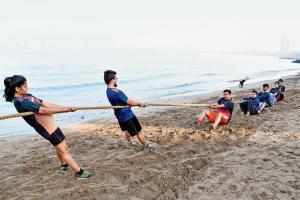
Players demonstrate a sitting foul at a training session at Dadar beach. Pics/Shadab Khan
On a Sunday morning at Dadar beach, strays bark at the sight of nine men and women, divided into two teams, pulling the ends of a thick rope. Whether they are protesting or cheering at the sight of this, we don't know. But what we do know is that both teams are equally strong and we cannot gauge if one of them will cross the white line any time soon. It is a test of strength as much as it is a test of patience.
Commonly known in the sub-continent as rassi kheench, tug of war (ToW) is a sport so widely loved — it is a classic during family picnics and school trips — that when you mention it as a game governed by a federation, you're likely to see many shocked faces. Our parents were, too, when we took up the game back in school at the district level. So, the training session at the beach looks all too familiar. But for Satish Kharatmal, 28, it's just another day at work.
Trending Stories
Latest Photos
Latest Videos
Latest Web Stories
ADVERTISEMENT
Mid-Day Fast
ADVERTISEMENT