Home / Mumbai-guide / Things To Do / Article /
Dr Ramachandra Guha: Environmental debate should go beyond climate change
Updated On: 06 December, 2024 07:15 PM IST | Mumbai | Nandini Varma
In his new book, historian and environmentalist Dr Ramachandra Guha traces the multilayered thoughts and debates on environmentalism in early 20th century India



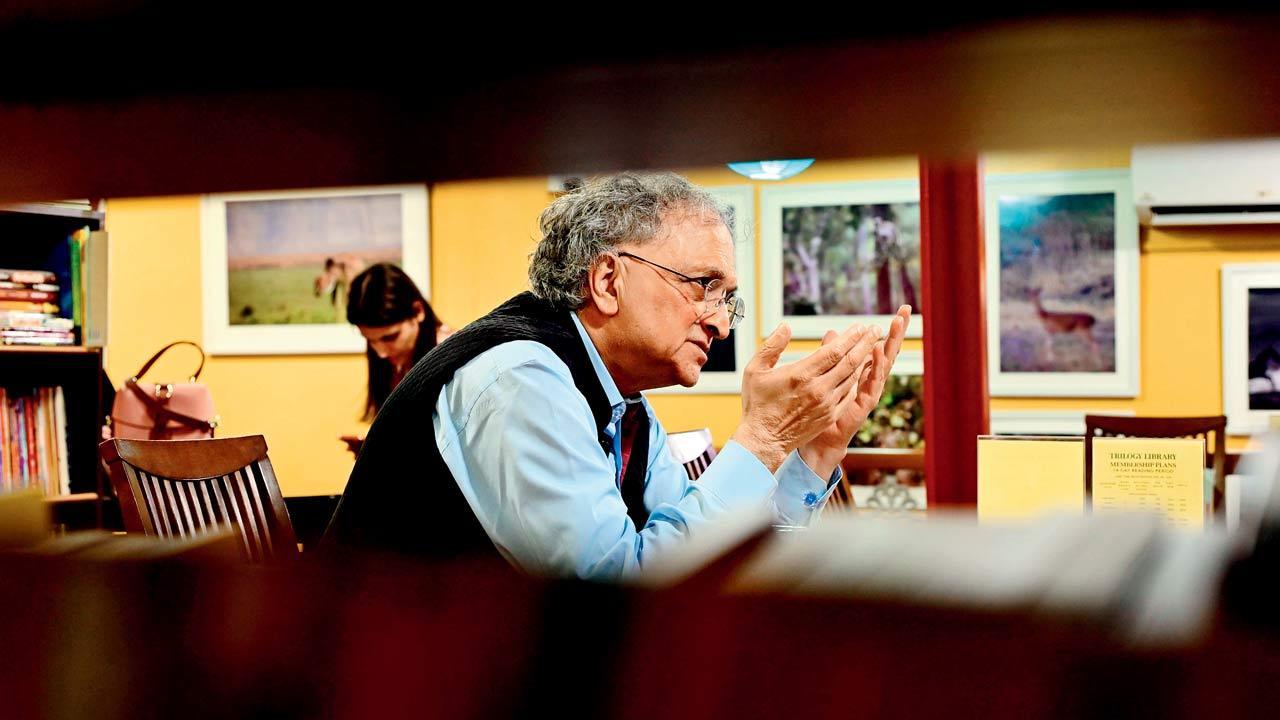
Dr Ramachandra Guha talks about his new book at the Bandra-based bookstore. Pics/Nimesh Dave
Wisdom demands a new orientation of science and technology towards the organic, the gentle, the non-violent, the elegant and beautiful.” These words are by the 20th century British economist EF Schumacher from his work, Small is Beautiful. They echo a common strain that runs through the historian and environmentalist Ramachandra Guha’s new book, Speaking with Nature (HarperCollins India). He traces the contribution of 10 thinkers of the 20th century, including Rabindranath Tagore, Mira Behn, Patrick Geddes and Kumarappa, who argued for sustainable and gentle ways of living at the time of high industrialisation. Most parts of the world had been witnessing a stark change in their economy, and colonial India was no different. Guha notes this period as one which marks the origins of environmental thinking in the country. The ideas emerged as a response to the large-scale felling of trees, excessive use of chemical fertilisers, lack of clean water, improper use and distribution of the resources in the farms, and gross levels of inequality.
Guha stepped into the field of environmentalism by accident. We catch up with him at Trilogy, the Bandra-based library and bookstore, to understand how. He reflects on his early days as a researcher and credits his professors from his doctoral years at IIM Calcutta. On learning that Guha was from Dehradun, professor Jayanta Bandyopadhyay, a visiting faculty at the institute, had suggested that the Chipko Movement, with its roots in Garhwal, was something that he could look up. “There have been journalistic writings [on the movement], but there have been no sociological studies. Why don’t you write about it?” Guha recalls Bandyopadhyay’s words. “He had planted the idea in my head. Once I was in the field, I was consumed by it.” Forty years later, Guha continues to be a leading scholar in the subject, from having published his research on the Chipko Movement in his 1989 book, The Unquiet Woods, to his collaborative efforts with the ecologist Madhav Gadgil, his work on the global history of environment movements, and now, his latest endeavour.
Trending Stories
Latest Photos
Latest Videos
Latest Web Stories
ADVERTISEMENT
Mid-Day Fast
ADVERTISEMENT

ADVERTISEMENT