






Home / Mumbai-guide / Things To Do / Article /
Do you love maps? Attend this exhibition that introduces viewers to cartography
Updated On: 29 April, 2023 09:17 AM IST | Mumbai | Sammohinee Ghosh
The second edition of a display on Subcontinental maps focuses on the nitty-gritty of survey charts and related histories

Listen to this article :
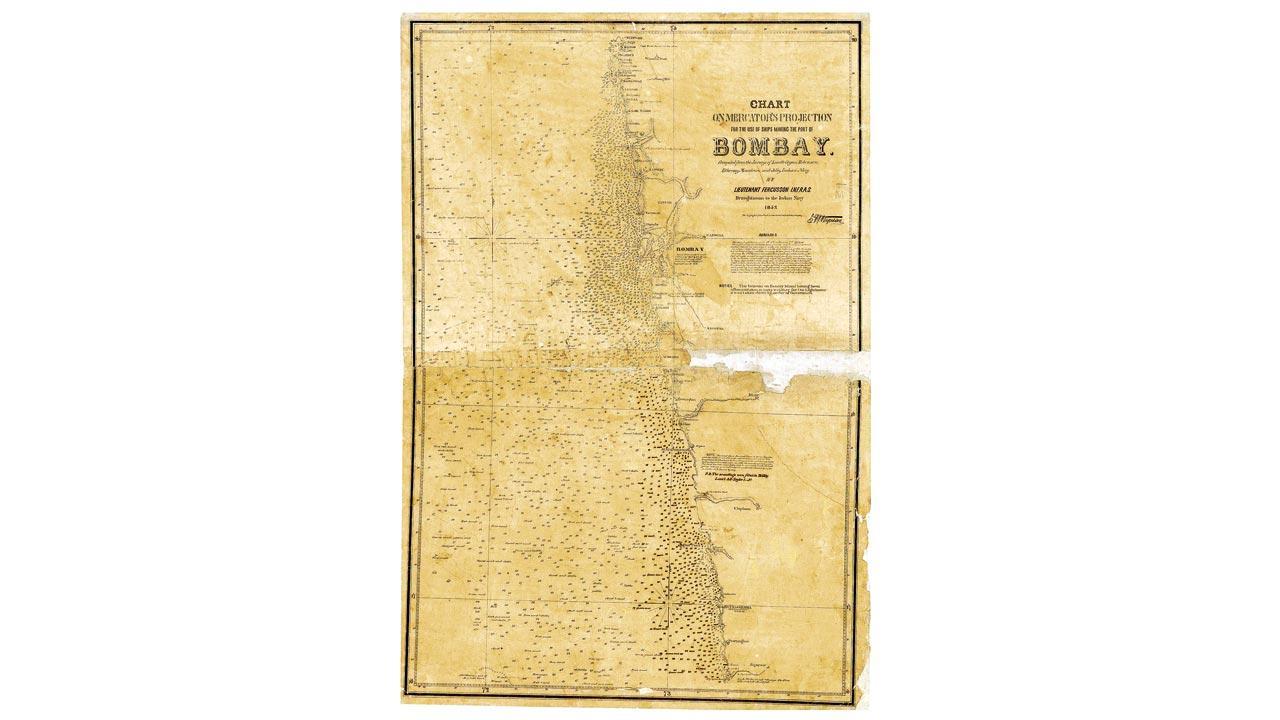
The Bombay mercator map, 1852. Pic Courtesy/Past Perfect
This writer is intrigued by big and wide lands, mighty mountains and unfathomable oceans being shrunk and fit onto a piece of paper. Maps make us feel as if we can hold a sizable chunk of the world in our palms. And the sheer variety of maps — ranging from the ones that narrate tales of conquest and capture to the ones on espionage, power play, revenue and more — make them a passionate pursuit. An upcoming one-month-long exhibition titled Mapped! — Surveys that left behind a legacy, will introduce viewers to a multitude of maps that not only elaborate on the journey of cartography, as a field of inquiry, but also reference periods in history.
The exhibition is being organised by The Urban Heritage Committee of the Rotary Club of Bombay and The Asiatic Society of Mumbai. It has been curated by Past Perfect, a heritage management platform. About the display, Dr Shehernaz Nalwalla, vice-president of the Society, shares, “Last year, we shone a light on conservation processes. This year, we are focusing on survey maps. We are probing the earliest mappings of the Indian Subcontinent. The activity was first started by William Lambton and was later taken up by his assistant George Everest.” Some surveys could not have been conducted by the Britishers as the locals became hostile in their presence. So they had to train Indians who were called Pundits. “Pundits would often disguise themselves as monks or travellers to get into places and study them. These instances stand out as examples of positive British-Indian enterprise,” Nalwalla notes.
Trending Stories
Latest Photos
Latest Videos
Latest Web Stories
ADVERTISEMENT
Mid-Day Fast
ADVERTISEMENT

ADVERTISEMENT