






Home / Mumbai-guide / Things To Do / Article /
Our gaothan, our art gallery
Updated On: 20 February, 2021 08:48 AM IST | Mumbai | Sukanya Datta
A public art initiative by East Indian residents of Marol Gaothan’s Oleria has given the locality a vibrant makeover that highlights their centuries-old traditions

Listen to this article :
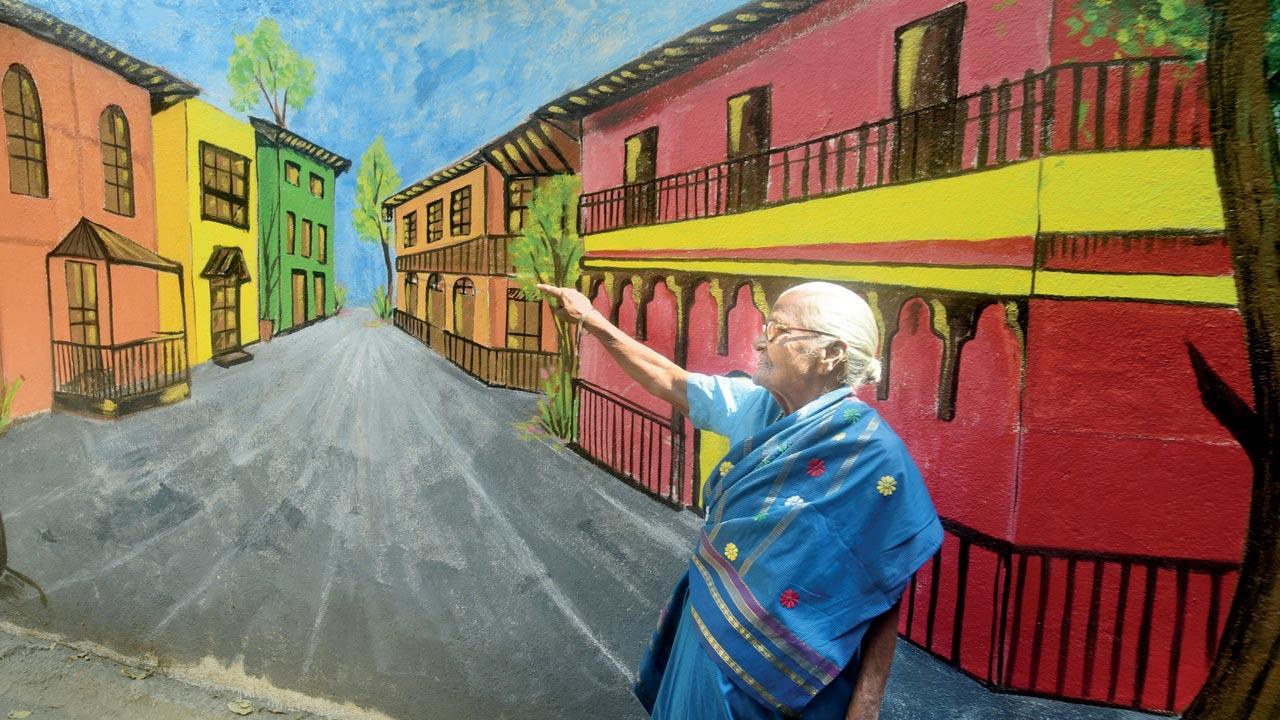
Victoria Prasad, a nonagenarian and one of the oldest residents of the gaothan, sports a lugra. Pics/Atul Kamble
The GPS on your phone might not be of much help once you veer off the main road to find Mumbai 59, in Marol Gaothan. If the many Pereira, D’Souza or Pimenta name plates can’t guide you, ask around for “the wall painting village”, and you’ll be led to Oleria, one of the 14 zones comprising the gaothan. Narrow, winding cobbled streets dotted with crosses dating back to the 1500s, quaint gable-roofed houses that once sported Mangalore tiles and occasional patches of green inside cemented courtyards — it’s a miracle how Oleria has managed to retain its old-world charm despite the visible onslaught of urbanisation. And its East Indian residents — around 155 families — have come together to preserve their heritage through the Gaothan Art 59 Project.
The art project has propelled a complete makeover of the tiny neighbourhood, with residents tying up with a gang of grafitti artists who go by Wicked Broz to paint the walls spanning an approximately 700-m stretch. Brian Pereira, a 62-year-old resident, shares that the initiative kicked off in January, after some locals including him decided to give their walls a facelift. “More residents got interested, and we got together and thought, ‘Why not paint the walls with the theme of our community’s traditions?’ That way, the youth will get to see our customs, and the place will flaunt a clean look,” he explains. Omkar Dhareshwar, co-founder, Wicked Broz, tells us the idea was to revive the community’s pride in its past: “Over two weeks, 14 of us painted the walls along with residents. It was a lot of fun, with the senior citizens and youth joining in to recreate the sights and sounds of the gaothan from 100 to 200 years ago.”
Read Next Story
Trending Stories
Latest Photos
Latest Videos
Latest Web Stories
ADVERTISEMENT
Mid-Day Fast
ADVERTISEMENT

ADVERTISEMENT