






Home / Mumbai / Mumbai News / Article /
Best prevention is vaccination and Covid-appropriate behaviour
Updated On: 10 September, 2021 07:54 AM IST | Mumbai | Vinod Kumar Menon
As WHO labels Mu a variant of interest, and variant C.1.2 is being monitored, doctors warn they have immune escaping properties and may be more infectious, spreading and mutating faster

Listen to this article :
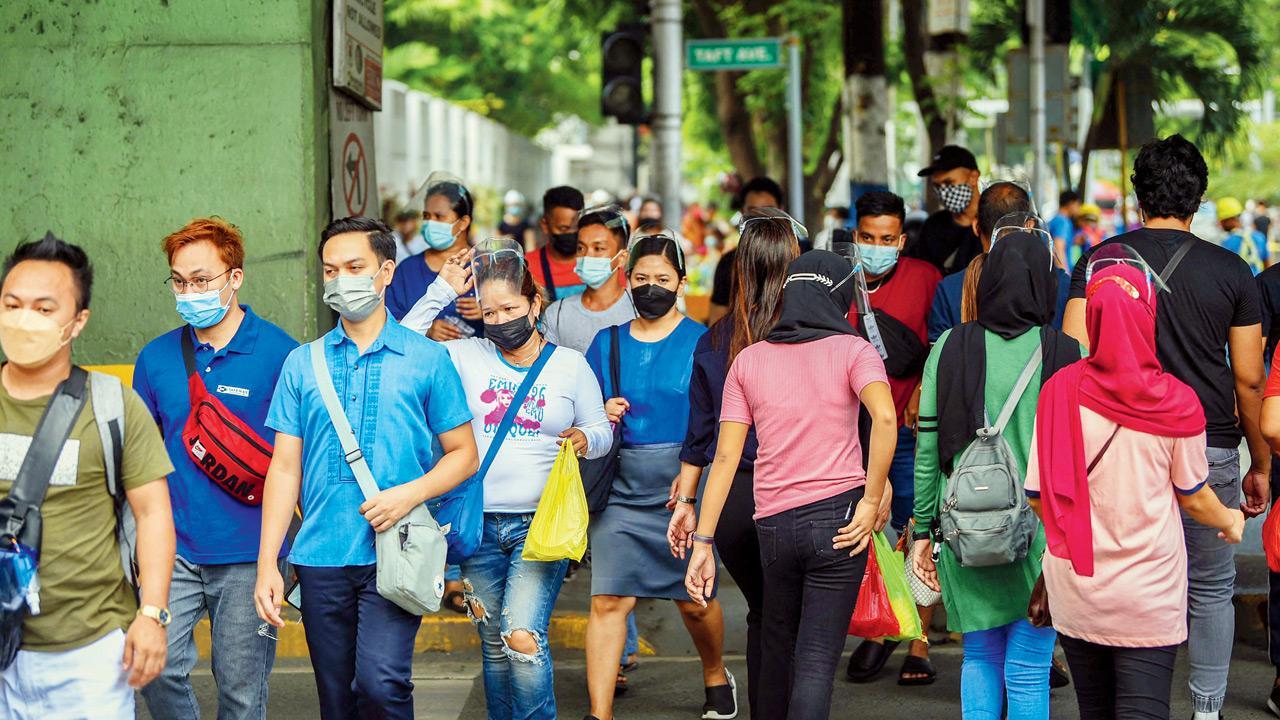
People cross a street in Manila on September 7, a day before the authorities lifted a stay-at-home order amid record infections fuelled by the contagious Delta variant. Pic/AFP
The global surveillance on Covid-19 variants has led to the identification of four ‘Variants of Concern (VOC)’ — Alpha, Beta, Gamma and Delta, and five, namely Eta, Iota, Kappa, Lambda and Mu ‘Variants of Interest (VOI)’ based on the criteria of their transmissibility, disease severity, immune escapability, etc. The variants have emerged as a result of rapid multiplication of the SARS-COV-2 virus that causes Covid-19. The variants are defective RNA strands that tend to alter the functions of the Covid-causing virus, making it more damaging or less damaging to the human body.
With the beginning of the festive period, crowding in public places and transport facilities is seen. Breach in Covid appropriate behaviour will inevitably cause a surge in infection rates best described as the third wave by health experts. While health care experts are concerned about the Delta variant, new variants like C.1.2 and B.1.621 or Mu are emerging in some countries. Doctors warn that these variants spread and mutate at a rate even faster than Delta.
Trending Stories
Latest Photos
Latest Videos
Latest Web Stories
ADVERTISEMENT
Mid-Day Fast
ADVERTISEMENT

ADVERTISEMENT