






Home / Mumbai / Mumbai News / Article /
Here's a chance to see precision instruments that showed the world Raman Effect
Updated On: 10 May, 2018 07:03 AM IST | Mumbai | Benita Fernando
From a 200-year-old theodolite that criss-crossed India to the spectrometer that showed the world the Raman Effect, here is a brief, and rare, chance to see these historical scientific instruments

Listen to this article :
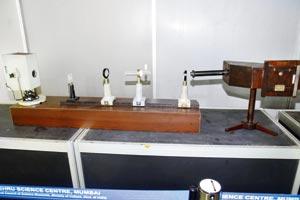

The spectrometer was used to observe the Raman Effect in action
It took 70 years, six surveyors, hundreds of workers, and thousands of miles on foot to complete the Great Trigonometrical Survey of India. The survey was initiated in 1802 by an infantry officer, William Lambton, in the expanding reign of the East India Company, to chart a map of the British territory from then Madras to Mangalore. The outcomes of this survey are relevant and indispensable even today: the map of the Indian subcontinent as we know it, the exact size of the Earth, the height of the Himalayan giants — Everest, K2 and Kanchenjunga — and other such scientific data, all came from this historical survey.
Trending Stories
Latest Photos
Latest Videos
Latest Web Stories
ADVERTISEMENT
Mid-Day Fast
ADVERTISEMENT

ADVERTISEMENT