






Home / Mumbai / Mumbai News / Article /
Is someone really out there?
Updated On: 20 April, 2025 08:06 AM IST | Mumbai | Nishant Sahdev
From marine plankton on Earth to possible biosignatures in space—a single molecule might answer the eternal question about alien life

Listen to this article :
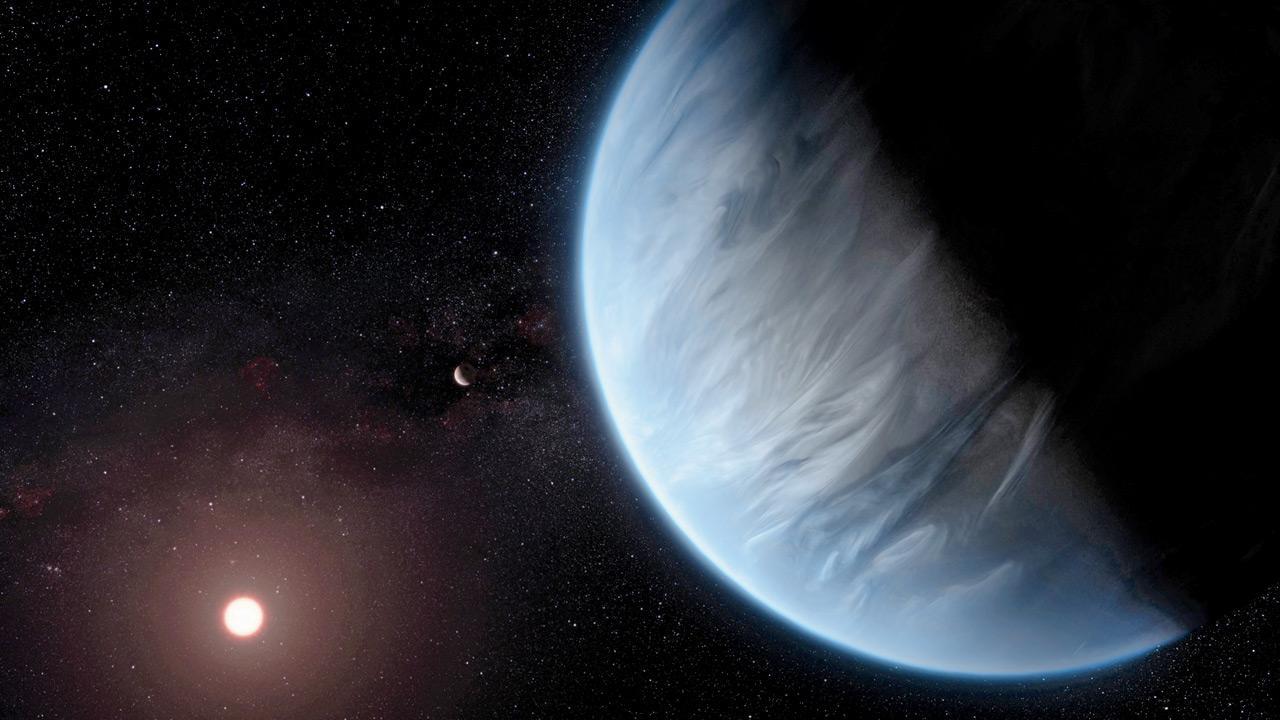
An artist’s impression, released by ESA/Hubble, of the K2-18b super-Earth. PIC/PTI
For as long as humans have gazed at the night sky, we've asked a question both simple and profound: Are we alone in the universe? Once the domain of philosophers and science fiction writers, that question has become the subject of serious scientific inquiry. And now, thanks to a faraway planet and the most powerful space telescope ever launched, we may be closer than ever to a real answer.
The planet in question is K2-18 b, orbiting a red dwarf star roughly 120 light-years away in the constellation Leo. It was discovered in 2015 and, at first, was just one among thousands of exoplanets—worlds outside our solar system—discovered over the past three decades. But recent findings using NASA’s James Webb Space Telescope (JWST) have thrust this planet into the spotlight.
Read Next Story
Trending Stories
Latest Photos
Latest Videos
Latest Web Stories
ADVERTISEMENT
Mid-Day Fast
ADVERTISEMENT

ADVERTISEMENT