Home / News / India News / Article /
Devdutt Pattanaik: Aggregation of Buddhist atoms
Updated On: 01 July, 2018 06:30 AM IST | Mumbai | Devdutt Pattanaik
They clarify that there is a soul within every individual living (jiva-atma) being and there is a cosmic soul that encompasses the universe (param-atma)





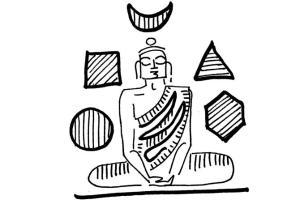
Illustration/Devdutt Pattanaik
 The fundamental difference between Hinduism and Buddhism rests on the idea of the soul or atma. Hindus say that there is a soul. They clarify that there is a soul within every individual living (jiva-atma) being and there is a cosmic soul that encompasses the universe (param-atma). By contrast Buddhists believe that there is no soul in the universe. What we call consciousness is actually an aggregation of various elements!
In the Buddhist worldview, the fundamental elements of the world are: Earth, Fire, Water, Wind and 'Aakash' or Space and what we nowadays refer to as radiation. In Japan when a person dies, the grave is often marked by a tombstone which has five symbols - square for the earth, circle for water, triangle for fire, crescent for the wind and an octagon or an almond shaped crown to represent space. This is the Buddhist equivalent of the Christian concept: you are dust, and you return to dust.
Trending Stories
Latest Photos
Latest Videos
Latest Web Stories
ADVERTISEMENT
Mid-Day Fast
ADVERTISEMENT