






A rebel before #MeToo
Updated On: 28 October, 2018 06:26 AM IST | Mumbai | Sumedha Raikar Mhatre
Reading actor Hansa Wadkar's memoir amid the sexual harassment storm reminds you of a gutsy woman who resented the male-controlled film industry way back in the 1930s

Listen to this article :
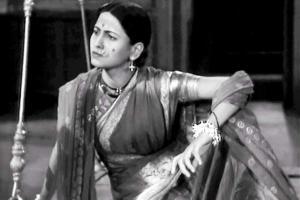
Actor Hansa Wadkar essayed lead roles in Marathi and Hindi films in the 1930s and '40s
 To dress up like a man in a kurta-pyjama-coat and go pillion riding in the night — this was one of the favourite pastimes of actor Hansa Wadkar (1923-71), when she essayed lead roles in Marathi and Hindi films in the '30s and '40s of the last century. In her memoir, Sangtye Aika (I Tell, You Listen), published in 1970, she recalls her strong urge to "hire cabs in the night and dine out at unearthly hours in Pune, just to prove that we could do anything beyond the set timings." Once, when she was seated behind senior thespian Raja Paranjpe — her director in the film Pudhcha Paul, which translates to The Forward Step — she insisted that he zoom past the desolate Aundh locality. Paranjpe, who was riding at breakneck pace, lost control midway and fell off his bike; he was hurt badly. Wadkar was not seriously injured, but she lost Paranjpe's friendship after the accident.
Amusingly, this was around the period (1949) when she was playing the part of revered saint poetess Janabai, under the Prabhat Film Company's prestigious banner. I laughed at the irony of the situation, which is beautifully etched in Sangtye Aika — my reading preference for the Dussehra holiday. The holiday ended with revisiting the Shyam Benegal-directed Hindi film Bhumika (1977), which is inspired by Wadkar's journey. For over two weeks, I was absorbing voices of women from the Indian film industry, mostly performers who recalled their histories of sexual and workplace harassment. At the root of these stories were unfair gender equations. The personal had turned political, and one Bollywood actor formed the nucleus of the conversation. That triggered my urge to visit a piece of writing, which spoke of the industry's male entitlement way back in the '30s and '40s. Wadkar's decision to make things public was unusually brave and asymptomatic of her times. Hers was not a sob story, but a coming to terms with a world (and an industry) that was governed by men.
Read Next Story
Trending Stories
Latest Photos
Latest Videos
Latest Web Stories
ADVERTISEMENT
Mid-Day Fast
ADVERTISEMENT

ADVERTISEMENT