A shared legacy in all its tangled knots
Updated On: 02 March, 2025 08:34 AM IST | Mumbai | Shweta Shiware
Inside Textiles from Bengal: A Shared Legacy exhibition, moments from Bengal’s past unfold, revealing new insights into the interwoven history of textiles, shaped by time, politics, and geography



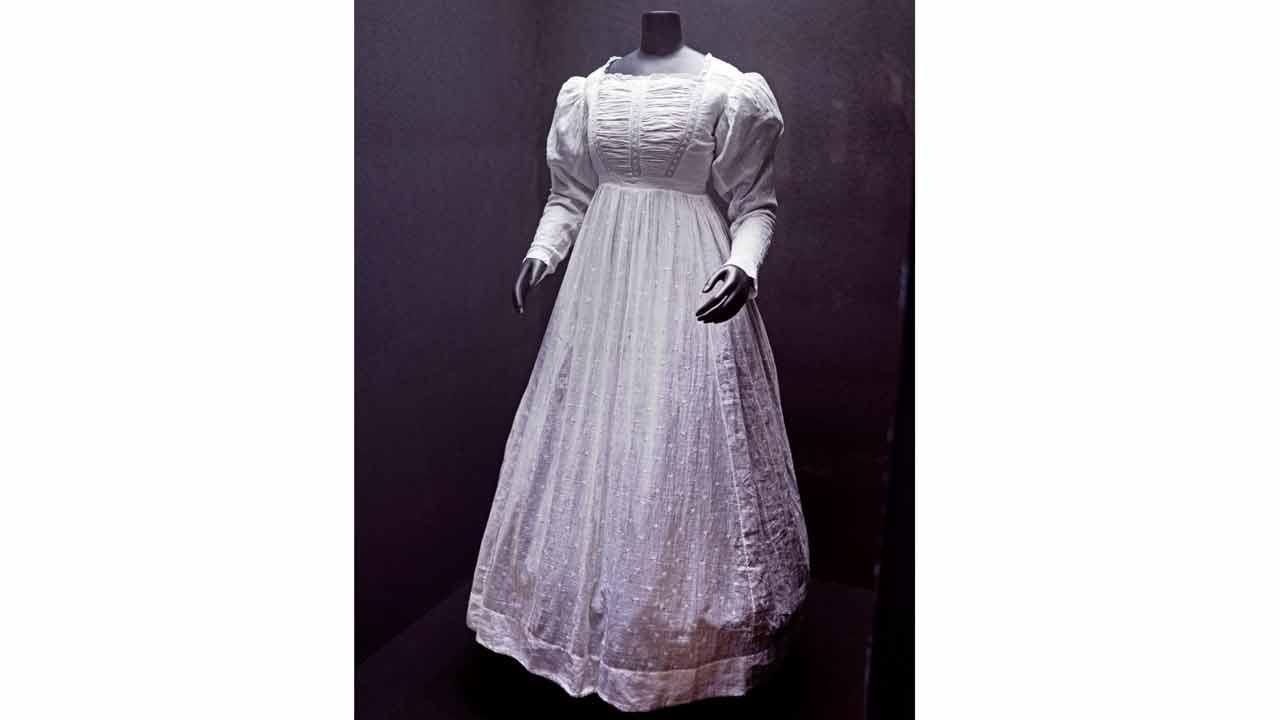
Muslin gown, woven and hand-embroidered fabric from Dhaka (Bangladesh), and tailored in France. Collection: Weavers Studio Resource Centre, Kolkata. PICS COURTESY/ SOUMYA PRASAD
 Textiles from Bengal: A Shared Legacy, on view until March 31 at the Kolkata Centre for Creativity, offers an immersive journey through Bengal’s textile evolution, from the Mughal era to the 20th century. The exhibition evokes reverence for the past and wonder at what might have been, telling the layered story of two Bengals—West Bengal and Bangladesh—across four centuries. From Mughal patronage to catering to European market demands, Bengal’s textiles evolved through political, cultural, and trade shifts, marked by key moments like the migration of weavers post-Partition and political upheavals that reshaped the region’s cultural fabric.
Presented by the Weavers Studio Resource Centre (WSRC), a Kolkata-based not-for-profit, and curated by Mayank Mansingh Kaul, the exhibition brings together 106 objects, including 81 textiles and 25 artefacts—clay models, a Mayurpankhi boat, and muslin swatches. Many pieces are rarely seen, with some making their public debut. It’s a deep dive across nine rooms, each with its own theme and colour palette, designed by Reha and Rajat Sodhi.
Trending Stories
Latest Photos
Latest Videos
Latest Web Stories
ADVERTISEMENT
Mid-Day Fast
ADVERTISEMENT

ADVERTISEMENT