






A wonderful weekend in Mantova
Updated On: 09 June, 2023 08:10 AM IST | Mumbai | Rosalyn D`mello
It was liberating to go off the grid after a long time and soak in the awe-inspiring sights of this charming small Italian town, which is overlooked by tourists

Listen to this article :
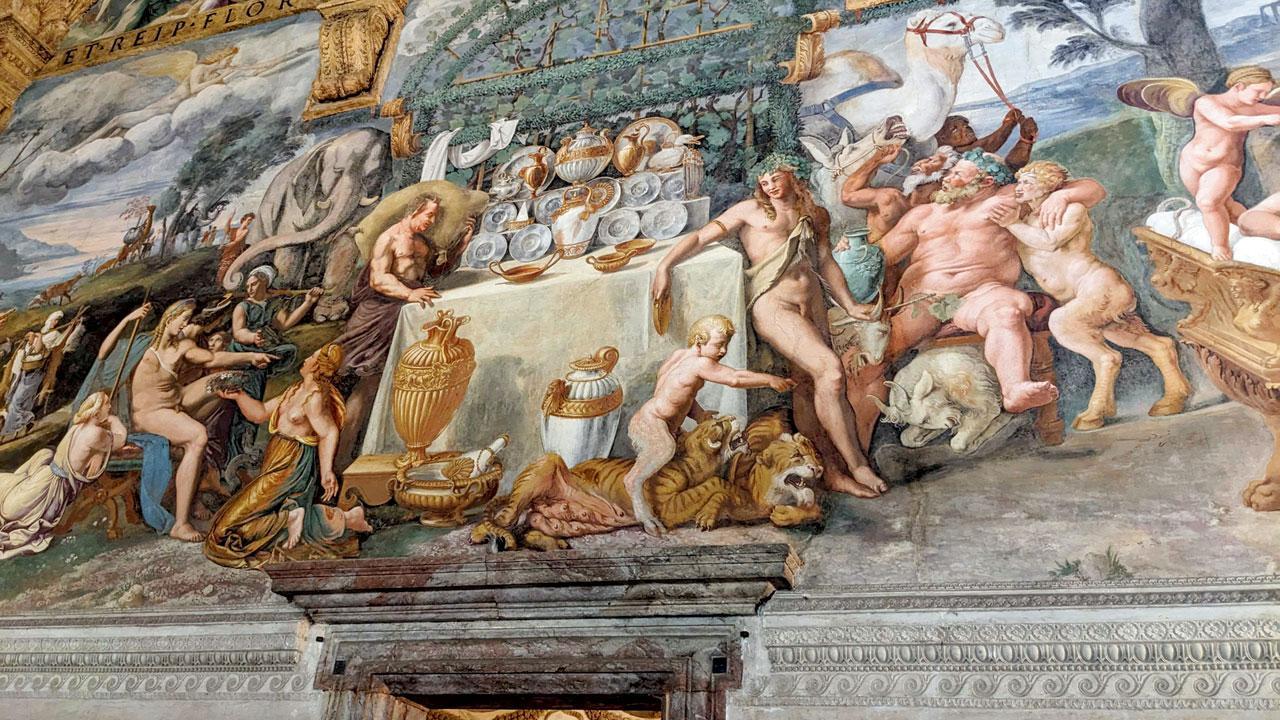
A fresco in the Palazzo Te, a magnificent palace designed by Giulio Romano
 I’m still basking in the afterglow of our trip last week to Mantova. It’s not a town that comes immediately to mind when one thinks of Italy. It isn’t spectacular like Rome, nor does it boast world-renowned works of art, like Florence. It’s not glamorous, like Lake Garda or the Amalfi coast. It’s really a small town that’s off most tourist itineraries. I want to say that’s what makes it special, but that’s only an aspect of it. Its size has a lot to do with its charm. It is easily navigable. You arrive at the train station and within less than 10 minutes, you are in the historical centre. Mantova grew as an island town surrounded by four man-made lakes that drew water from the river Mincio, a tributary of the river Po that descends from Lake Garda. The presence of freshwater whose surface is glazed with lotus lends the town a feeling of airy lightness. Where most Italian towns boast a slew of piazzas, Mantova has three principal ones, all within a stone’s throw from each other: Piazza delle Erbe, Piazza Sordello and Piazza Broletto. We decided to stay in a heritage hotel right at Piazza Sordello, which put us in the immediate vicinity of the Ducal Palace and the San Pietro Basilica.
We arrived on Thursday morning when the entire town was taken over by the weekly market comprising stalls selling all kinds of things from clothes to fresh pasta, brimming over with a bustling energy. I decided to take Thursday off from work to give myself the luxury of a long weekend; one of the wisest plans I’ve had in a long time. I really needed a time-out. Our last two trips to Frankfurt and Florence had been work-related. I was meant to review two shows in Frankfurt and I had been invited to Villa Romana in Florence to deliver a lecture performance. The part of my brain that was always planning, managing my anxieties, creating to-do lists and responding to emails urgently needed to switch off. I had recently felt inundated by deadlines and commitments. I had forgotten about how nervous I get each time I am supposed to present. It’s not just stage fright, it’s self-doubt. I worry that I will be perceived as boring, that the stuff that excites me might feel nerdy to others, or irrelevant, that I won’t be able to infect them with my enthusiasm.
Read Next Story
Trending Stories
Latest Photos
Latest Videos
Latest Web Stories
ADVERTISEMENT
Mid-Day Fast
ADVERTISEMENT

ADVERTISEMENT