






Ambedkar: Papads and milk
Updated On: 06 August, 2023 08:07 AM IST | Mumbai | Meenakshi Shedde
Rathore’s preface is delightfully titled “There will be blood”, so he’s looking to recreate a flesh and blood portrait of a revolutionary devoted to the annihilation of caste

Listen to this article :
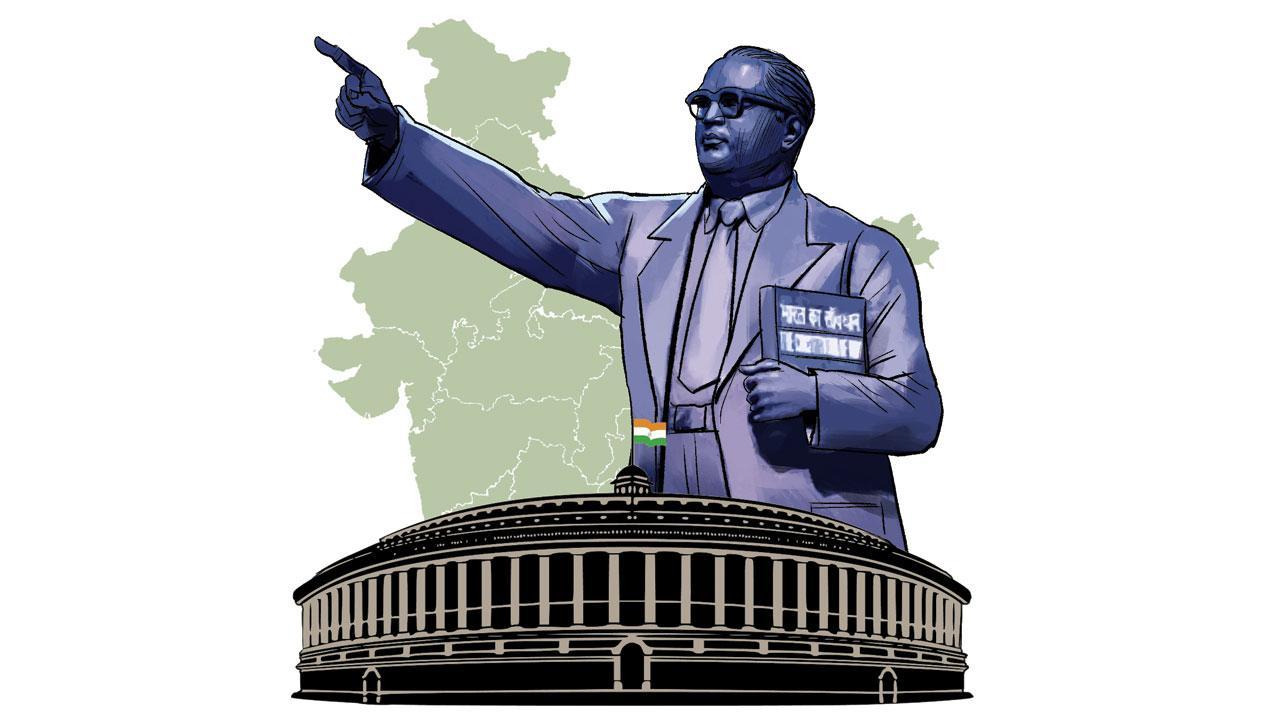
Illustration/Uday Mohite
 In his early days as a student in London, Dr Babasaheb Ambedkar struggled on a tight budget—though he wasn’t Dr or Babasaheb yet. He literally skipped lunch because he couldn’t afford it. For dinner, his landlady served him Bovril, a meat paste soup. Fortunately, he had “a supply of papad given to him by a Gujarati friend. Each night at 10 pm he would ration out four to eat, along with a cup of milk, to stave off hunger through the night”. This is one of many insights in the wonderful, vivid biography, Becoming Babasaheb: The Life and Times of Bhimrao Ramji Ambedkar, Birth to Mahad (1891-1929) by Aakash Singh Rathore (HarperCollins India, hardcover Rs 699; first of a two-part volume). It brings alive Dr Ambedkar’s life: despite horrific discrimination because of poverty and caste, he emerged as a remarkable scholar, barrister, leader of the Dalits and key architect of India’s Constitution. It is the latest in a number of his biographies by authors from CB Khairmoday and Dhananjay Keer, to Eleanor Zelliot, Gail Omvedt, and Christophe Jaffrelot, with Ambedkar’s own book Waiting for a Visa, including autobiographical fragments.
Rathore’s preface is delightfully titled “There will be blood”, so he’s looking to recreate a flesh and blood portrait of a revolutionary devoted to the annihilation of caste. His meticulous, original research and accessible style makes for an engrossing biography of a man who, like us—struggled to pay the bills, fell in love, dealt with crises—yet the average middle class Indian may have little in common with the relentless lifelong discrimination he faced, or indeed, his prodigious achievements. From a kid, one of 14 born in a Mahar (Dalit, untouchable) family in Mhow, Madhya Pradesh, who had to sit on a gunny sack cloth in a corner of the school classroom, to earn a BA (Elphinstone College, Mumbai), an MA and PhD in Economics from Columbia University, New York, and an MSc and DSc (Doctorate) in Economics from the London School of Economics, and a law degree at Gray’s Inn, London, are staggering achievements. He even submitted a paper proposing that the origins of caste lay not in race (Aryans subjugating Dravidians), but the control of women’s sexuality i.e. the practice of “beti bandi” or endogamy, marrying within the clan/community. He recommended ending this by promoting intercaste marriages. Unlikely he’d have called it love jihad, but essentially it promoted co-mingling—unlike the weaponising against minorities it has become today, that simply results in more body bags.
Read Next Story
Trending Stories
Latest Photos
Latest Videos
Latest Web Stories
ADVERTISEMENT
Mid-Day Fast
ADVERTISEMENT

ADVERTISEMENT