






Bollywood’s dance face-offs
Updated On: 13 August, 2023 04:59 AM IST | Mumbai | Meenakshi Shedde
Usha Iyer’s book is a fantastic and meticulous analysis of dancing women in Hindi cinema from 1930-1990s, and also including Tamil and Bengali cinema

Listen to this article :
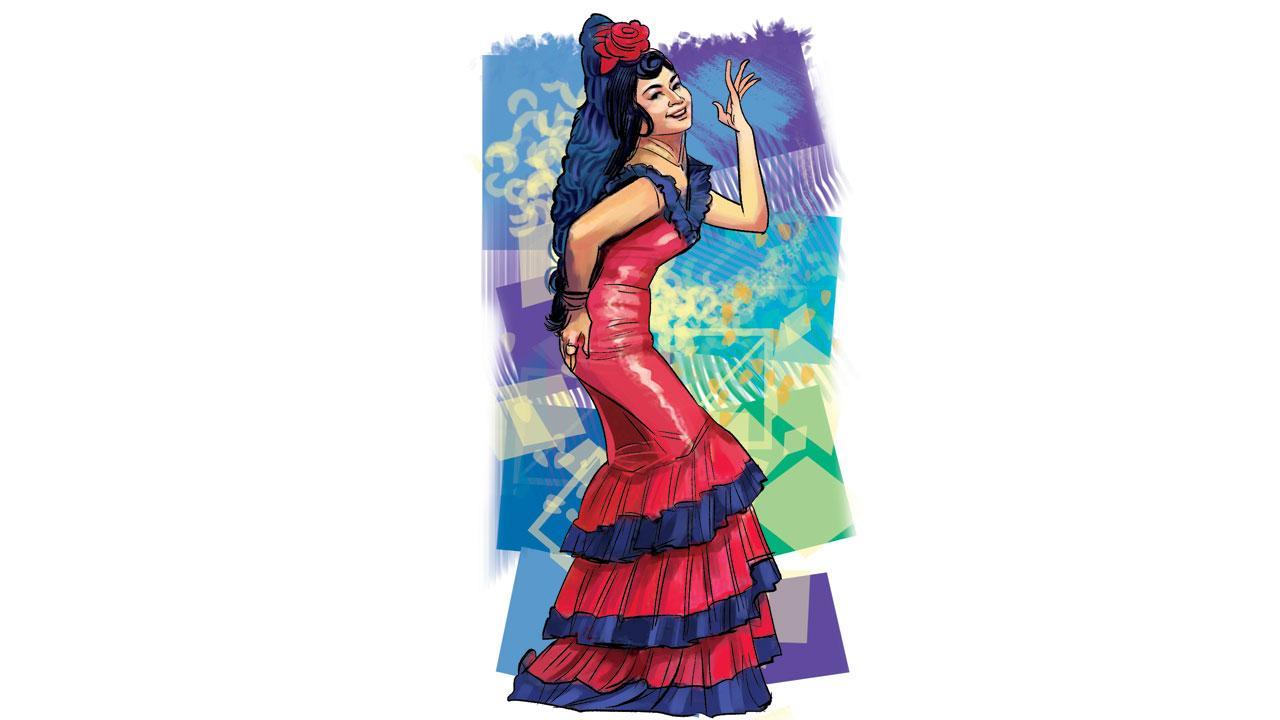
Illustration/Uday Mohite
 I’ve always been fascinated by dance. Any dance, including Bollywood. I’ve even taken classes in the lavani dance from Gururaj Korgaonkarji. It’s a traditional Maharashtrian folk dance, heavy duty or halka-sa erotic, depending on how you interpret it. I have been obsessed with Apsara aali, the lavani from Ravi Jadhav’s Natarang, and Sanjay Leela Bhansali’s extraordinary Mohe rang do laal from Bajirao Mastani. How even in a Hindi masala mainstream film, he shows incredible political daring, celebrating a historical, Hindu-Muslim romance in a time of right wing ascendancy, and combining multiple classical elements—Hindustani classical music, classical dance (kathak), ragamalika paintings and the tribute to Mughal-e-Azam. So it was with utter delight that I swooped on Usha Iyer’s book Dancing Women: Choreographing Corporeal Histories of Hindi Cinema (Oxford University Press, Rs 1,550 paperback).
Usha Iyer’s book is a fantastic and meticulous analysis of dancing women in Hindi cinema from 1930-1990s, and also including Tamil and Bengali cinema. She studies these dancing women through the lenses of choreography, feminism, female desire, agency, labour (all the people involved in ‘song picturisation’, including choreographer, stand-ins, music composers, lyricists, singers, musicians, background dancers), history, caste, religion, colonialism, sexuality, the dancer’s status vis-à-vis the heroine and hero, their mobility (dancing-wise and status-wise) and more. Despite its academic instincts—it bristles with “choreographing architectures of public intimacy” and “a movement-based taxonomy of song-and-dance sequences,” the knowledge and passion that it passes on to us is incomparable. Iyer quotes from interviews with many dancers and choreographers, including Waheeda Rehman, Vyjayanthimala, Madhuri Dixit and Saroj Khan. There’s even a password-protected website to accompany the book, with short clips of many of the dance numbers it discusses. Iyer, a PhD from the University of Pittsburgh, is Assistant Professor of Film and Media Studies in the Department of Art and Art History at Stanford University, US.
Read Next Story
Trending Stories
Latest Photos
Latest Videos
Latest Web Stories
ADVERTISEMENT
Mid-Day Fast
ADVERTISEMENT

ADVERTISEMENT