






Decoding Ganesha’s parenthood
Updated On: 17 September, 2023 07:07 AM IST | Mumbai | Devdutt Pattanaik
This violence of the battlefield, that provides protection, is not disconnected from the violence in the kitchen, that provides nourishment.

Listen to this article :
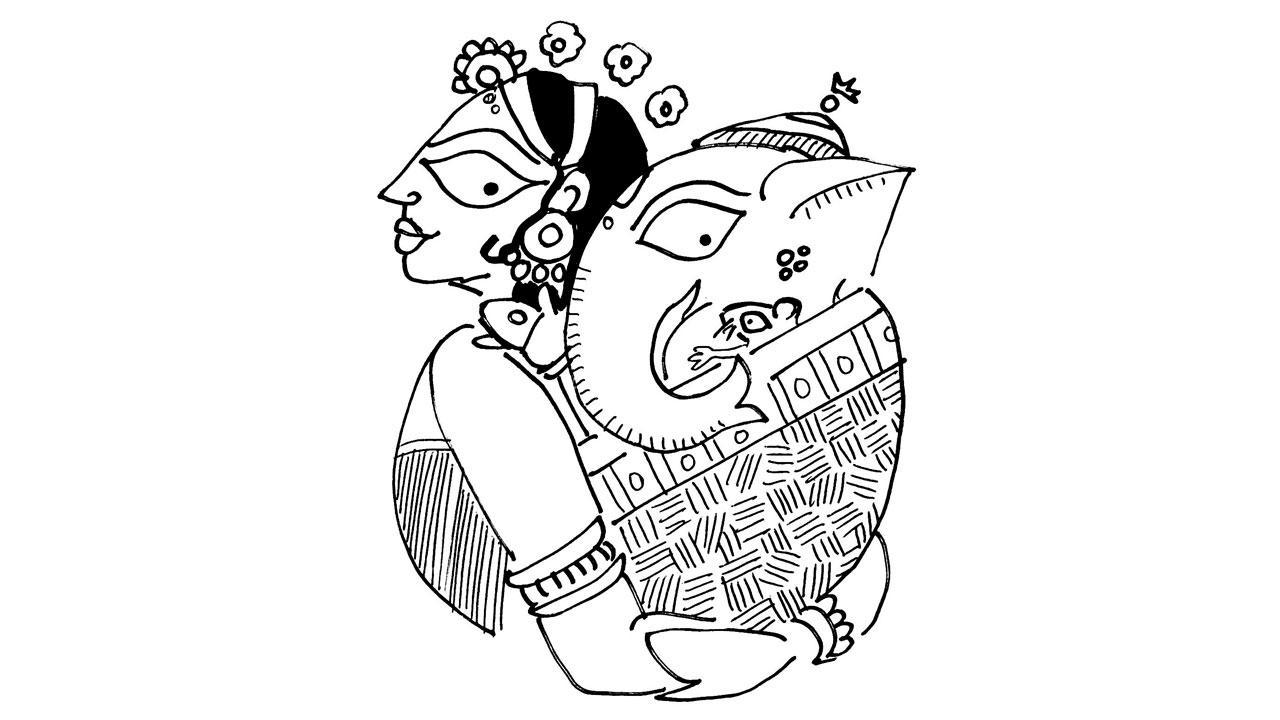
Illustration/Devdutt Pattanaik
 Ganesha’s arrival, in the latter half of the monsoon, marks the transformation of Shiva, the hermit, into Shankara, the householder. During this time, his mother is worshipped as Gauri, the homemaker. But a few weeks later, she is worshipped as Durga for nine nights. She appears as a 10-armed goddess riding a lion or a tiger, battling a wild buffalo. She is dressed as a bride with bangles, necklaces, nose ring, earrings. But she is also a warrior, with weapons. She is a warrior-bride, protector and provider. Her name evokes the safety of the citadel (durg).
This violence of the battlefield, that provides protection, is not disconnected from the violence in the kitchen, that provides nourishment. The act of turning raw food into edible food is a violent one. You have to peel, pound, chop, crush, knead, roast, steam, boil, fry the ingredients. Only then do we get food. Even before food reaches the kitchen there is violence—the cutting of trees, the uprooting of grass, the pruning of plants, the ploughing of fields, the threshing of grain, the grinding of cereals, the slaughter of pests, the castration of male animals, the culling of sick ones. And so, through the goddess we are told how violence is integral to nourishment.
Read Next Story
Trending Stories
Latest Photos
Latest Videos
Latest Web Stories
ADVERTISEMENT
Mid-Day Fast
ADVERTISEMENT

ADVERTISEMENT