






Hindutva’s charm for West Bengal
Updated On: 15 March, 2021 07:30 AM IST | Mumbai | Ajaz Ashraf
The social class of bhadralok, which is dominated by the upper castes — has ruled the nursery of Hindutva through one party or another. Upcoming polls will show if a politics bereft of the struggle of lower castes and communities can endure against the BJP

Listen to this article :
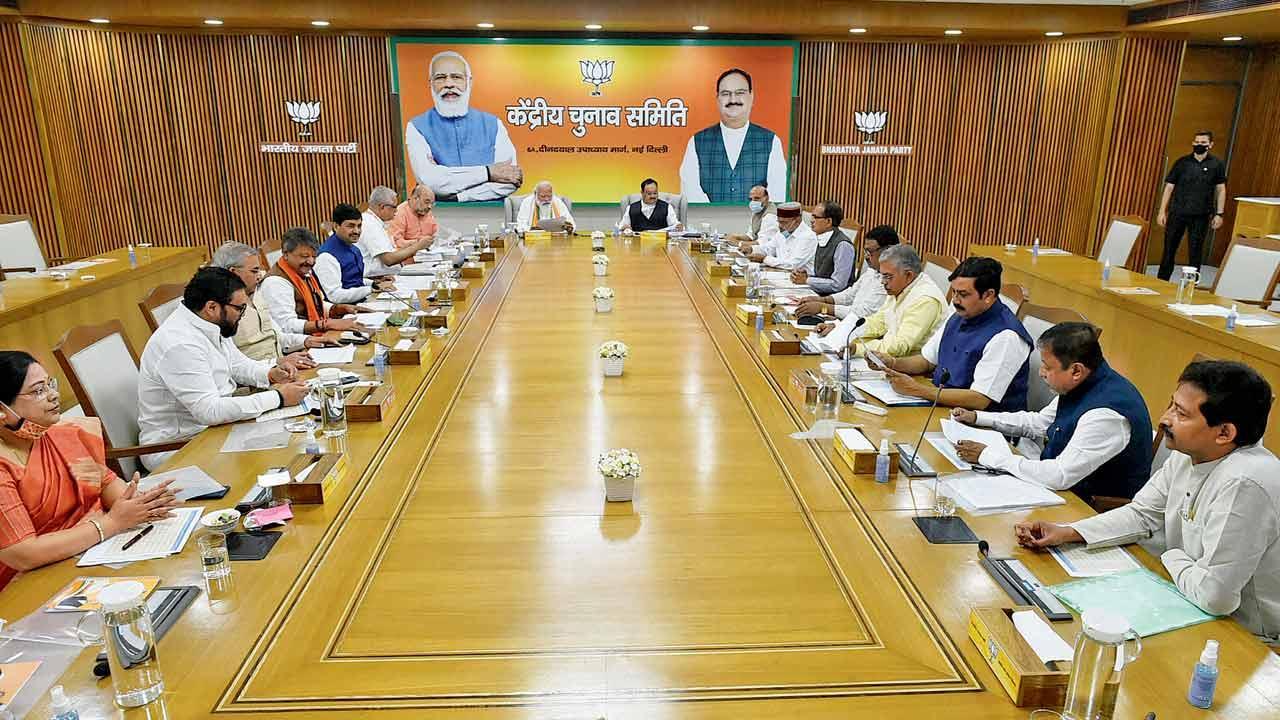
PM Narendra Modi chairs BJP’s Central Election Committee (CEC) meeting to select candidates for West Bengal Assembly polls in New Delhi on Saturday. PIC/PTI
 The Bharatiya Janata Party gazes upon West Bengal with the conqueror’s eye, for it knows that the party ruling in Kolkata often wins a large chunk of the 42 seats the state has in the Lok Sabha. A BJP victory in the West Bengal Assembly elections would enable the party to offset losses suffered elsewhere in the future war to control the Centre. The victory would likely decimate the communists, who are the BJP’s most steadfast ideological foe, and trumpet the limitation of regional identity rooted in language to counter the political-religious ideology of Hindutva, which seeks to culturally unite diverse Hindu social groups, often with conflicting interests, across India. This has always been an upper-caste project.
For the Rashtriya Swayamsevak Sangh, West Bengal is the Promised Land, so to speak. It was here RSS founder KB Hedgewar studied medicine, and was influenced by the political Hinduism of Bankim Chandra Chatterjee and Aurobindo Ghose. This is the land of Swami Vivekananda, whom the RSS re-imagined as the proponent of virile Hinduism. It is to this state Guru Golwalkar came to become a monk, but then abandoned his ascetic ambition to become the second chief of the RSS. West Bengal was the home of Shyama Prasad Mukherjee, the founder-president of the Bharatiya Jana Sangh (BJS), the BJP’s earlier avatar.
Read Next Story
Trending Stories
Latest Photos
Latest Videos
Latest Web Stories
ADVERTISEMENT
Mid-Day Fast
ADVERTISEMENT

ADVERTISEMENT