






Historian’s myth
Updated On: 06 July, 2025 10:49 AM IST | Mumbai | Devdutt Pattanaik
Hundreds of scholars seek out astronomy data, such as information on eclipses, from old manuscripts to date the war at Kurukshetra.

Listen to this article :
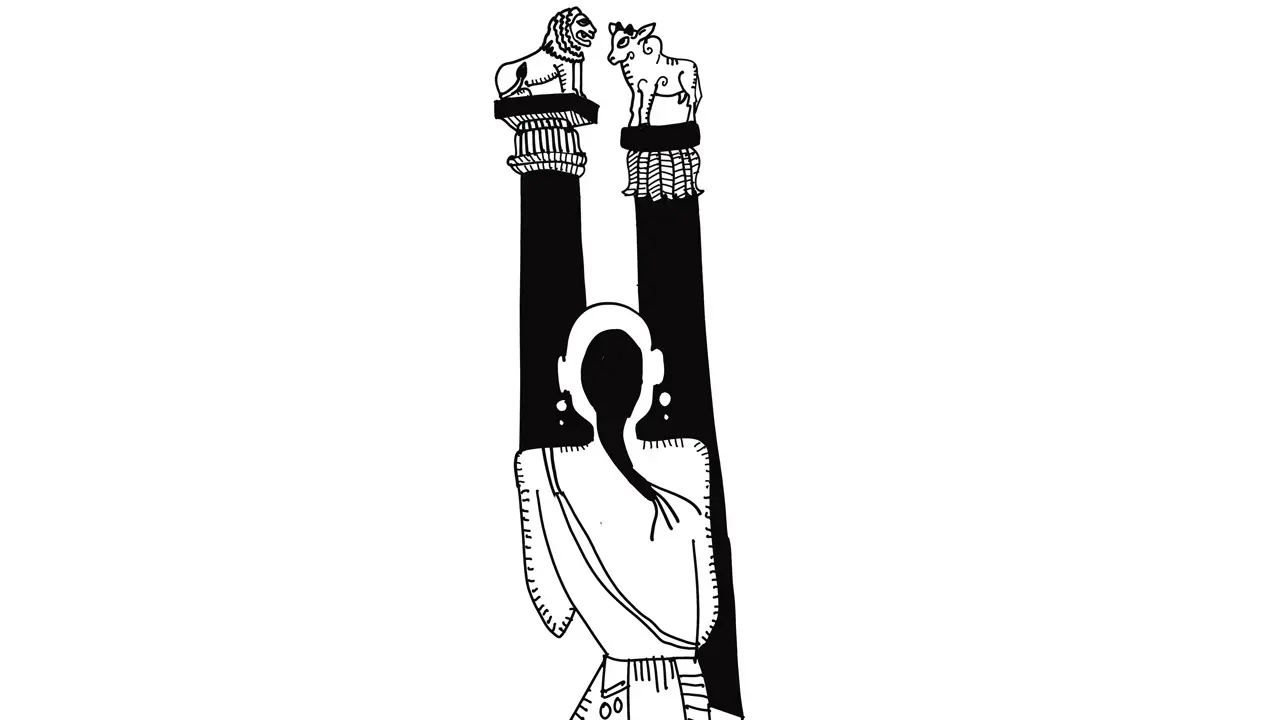
Illustration/Devdutt Pattanaik
 It is generally assumed that historians are objective and express ideas outside their cultural influence, owing to academic training. However, this is never true. Historians, like all other humans, live in myth. Very few admit it.
The social sciences are very different from the earth sciences. There is a large component of interpretation and argument that shapes the thesis. Some historians value evidence. Some place evidence in context, some cherry-pick evidence, and some ignore evidence altogether. Take the case of those who insist that the epic Mahabharata is a document of real historical events.
Hundreds of scholars seek out astronomy data, such as information on eclipses, from old manuscripts to date the war at Kurukshetra. Many dates have been proposed. The most popular one states that the war took place 5000 years ago, before 3000 BC. But around 3000 BC, horses had not been domesticated and chariots had not been invented. The pyramids had not been built. Chinese oracular bones did not exist. The Bronze Age Trading Network was in its early phases. This makes one doubt the 3000 BC date, unless one subscribes to pseudo-histories of pre Ice Age civilizations popular in social media. It cannot be part of peer-reviewed history that values the scientific process. Historians who do not engage with such ideas are often accused of being colonial and anti-tradition. Such ideas remain a matter of faith, popular in history channels that talk about alien invasions.
Read Next Story
Trending Stories
Latest Photos
Latest Videos
Latest Web Stories
ADVERTISEMENT
Mid-Day Fast
ADVERTISEMENT

ADVERTISEMENT