How Brahma lost his position
Updated On: 26 April, 2021 11:13 AM IST | Mumbai | Devdutt Pattanaik
This shift can be seen as the result of two factors: the rise of monastic orders like Buddhism and Jainism, and the increasing participation of common folk who had little patience with complex rituals and abstract ideas.





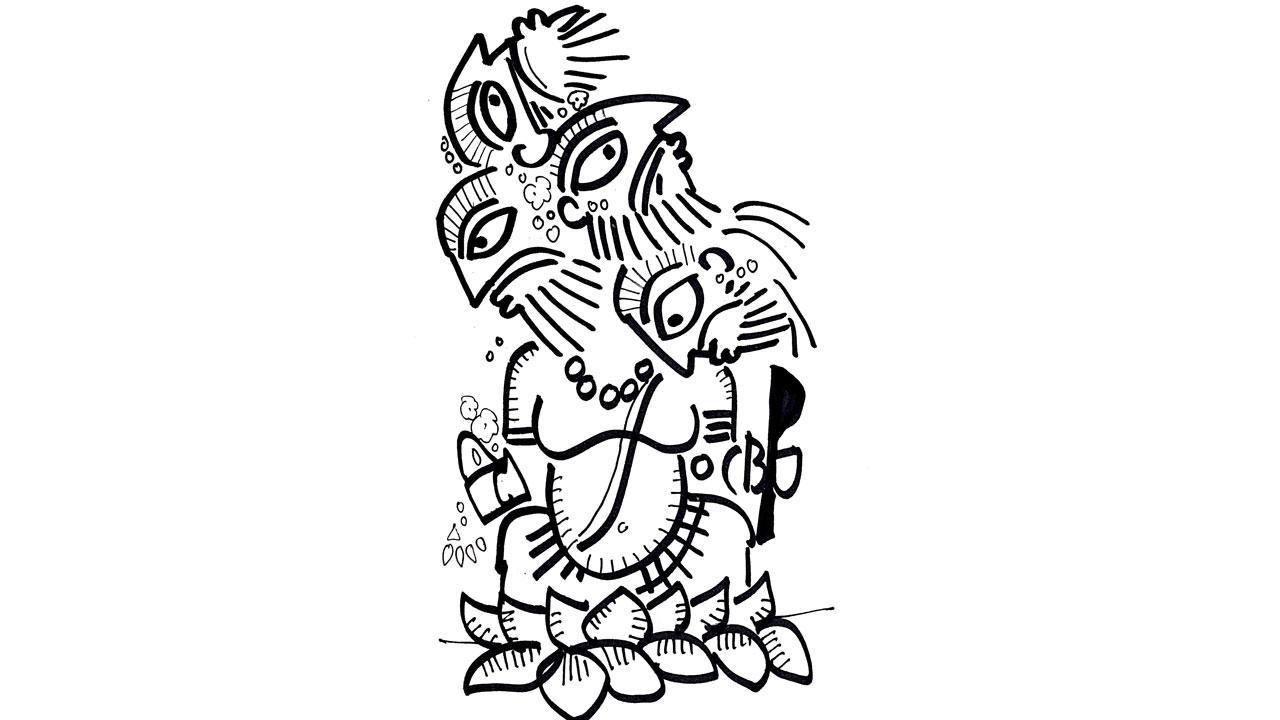
Illustration/Devdutt Pattanaik
 In Vedic times, 3,000 years ago, Brahma referred to ‘brahman’, the impersonal divine energy linked to consciousness, spirit and meaning. Gradually, in Puranic times, 2,000 years ago, the idea of a god named Brahma emerged. This god created all life and established codes of civilised conduct, and dharma. This shift can be seen as the result of two factors: the rise of monastic orders like Buddhism and Jainism, and the increasing participation of common folk who had little patience with complex rituals and abstract ideas.
In Vedic ritual manuals, Brahma was called Prajapati, god of progeny, who creates all living creatures in order to overcome his loneliness and to satisfy his hunger as per Brihadaranyaka Upanishad. In Mahabharata, Brahma tells Indra to perform rituals to remove the pollution resulting from his killing Vritra (a brahmin) and Namuchi (a friend). In Brahmanas, he takes the form of a boar called Emusha to raise the earth, and he takes the form of the fish who teaches Manu that dharma is about protecting the weak. These roles as boar and fish, that rescues the earth and establishes humanity, are eventually taken over by Vishnu’s avatars. In Ramayana, Brahma encourages Valmiki to tell the story of Ram. In Mahabharata, he encourages Vyasa to tell the story of the Pandavas.
Trending Stories
Latest Photos
Latest Videos
Latest Web Stories
ADVERTISEMENT

Ganeshotsav 2026

ADVERTISEMENT