






Intellectual innings in Innsbruck
Updated On: 08 October, 2021 07:09 AM IST | Mumbai | Rosalyn D`mello
It hasn’t been easy to assert my identity as an intellectual. A new phase of my life at Künstlerhaus Büchsenhausen enables a perceptual shift

Listen to this article :
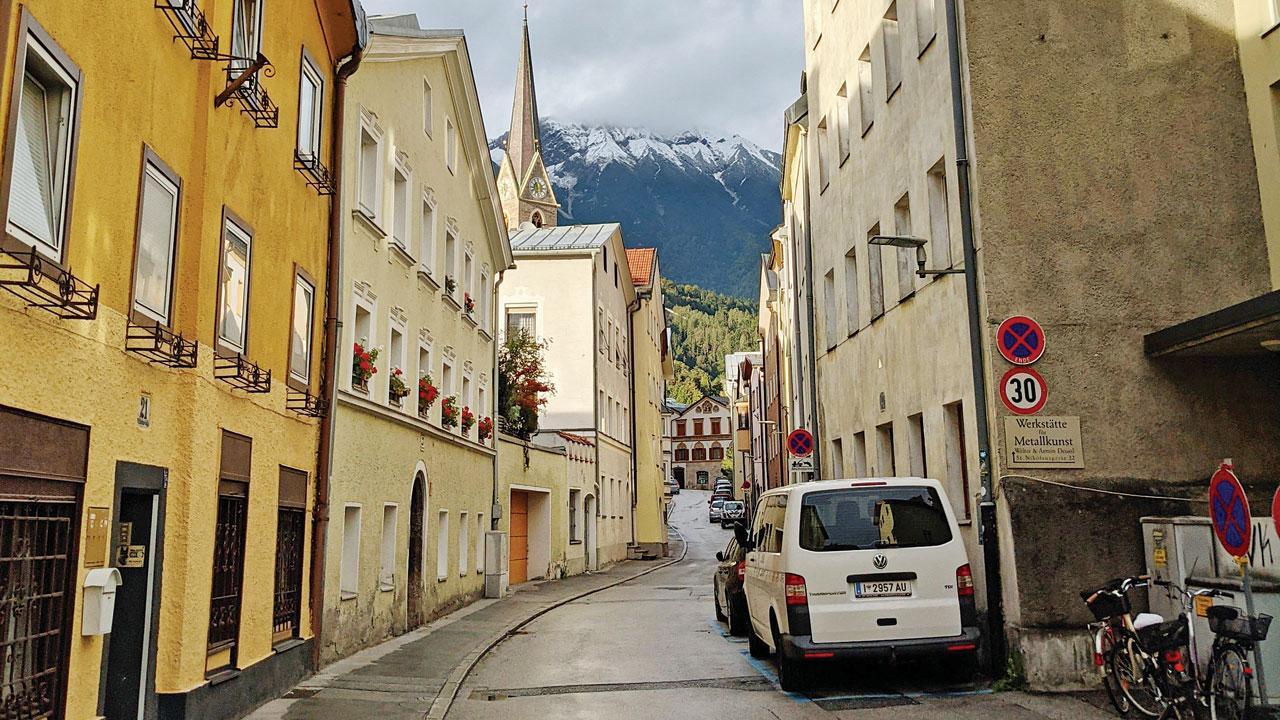
The art and theory residency is located in a castle in Innsbruck. Pic/Rosalyn D’mello
 In the beginning of October I began a new phase of my intellectual life as a fellow at Künstlerhaus Büchsenhausen, an art and theory residency located in a castle in Innsbruck. I had been excited to apply last year as it was one of few residencies I knew of that enabled art theorists and critics to extend ongoing research, offering residential, logistic, and production support. I was elated to be selected, and to find my name among three other artist-theorists whose proposals are so intriguing and urgent. Because, for the sake of sustaining my livelihood, I am compelled to wear multiple hats, functioning variously as proofreader, editor, art critic, writer, among other callings, I often find it difficult to assert my identity as an intellectual. In any case, women like me, of colour, from minority backgrounds within third-world contexts are not easily considered intellectuals. It is a status we have to claim for ourselves, which involves renouncing shyness and reluctance to wear the mantle, and believing, forcefully, in the immediacy and significance of what we have to contribute in terms of discourse. Especially in India I have been frequently invalidated by the various worlds in which I have operated. The literary world is unable to see the vastness of my oeuvre. Many magazine editors only contact me for my opinion on matters of women’s sexual agency, as if my writing was limited to the erotic. The art world has almost no conception of my literary work. Those who invite me as press to art festivals around the world are uninterested in thinking of me as anything other than an arts journalist. All of this is symptomatic of people like me who do not inhabit clear identities, whose practice is metabolic and invested in the slipperiness of discursive boundaries.
Additionally, to have to hold my head high in the absence of institutional validation has been challenging. No matter how much I tell myself that external validation is secondary, I have seen how its absence has affected my career, prevented me from exploring opportunities that are otherwise open to people with more mainstream dispositions. It is not easy to continue to persist when one is aware of how the forces of prejudice work against you. I am quite certain I am not alone in this feeling, that many of you reading this will identify with the kind of strength of will it requires in order to endure. When I say that I am currently thriving, it has a very different resonance because of how much I have had to struggle to arrive at this point, especially when nothing was ever handed to me on a platter, and all the networks of solidarity to which I have had access are the consequence of intersectional feminist sisterhood and goodwill.
Read Next Story
Trending Stories
Latest Photos
Latest Videos
Latest Web Stories
ADVERTISEMENT
Mid-Day Fast
ADVERTISEMENT

ADVERTISEMENT