Marathi manoos should also own up to the decay of their mother tongue
Updated On: 17 January, 2022 07:09 AM IST | Mumbai | Dharmendra Jore
Compulsion of prominently writing shop signs in state language reflects how Maharashtra’s population has failed to make successive governments give Marathi due recognition





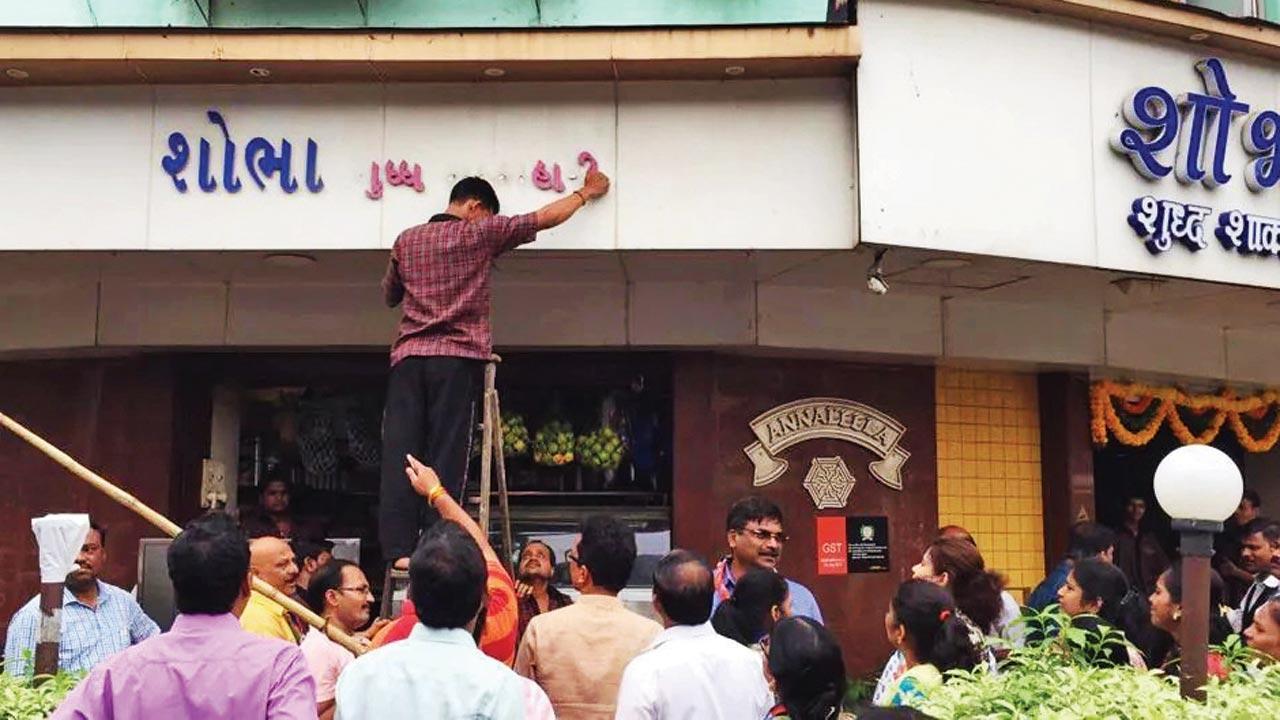
A restaurant gets its signboard changed. File pic
 The old diktat in new packaging that makes it compulsory to write the signs of shops and establishments in Marathi in a size bolder than any other language used has evoked, a strong response from shop owners, who have cited a court case they fought successfully against the order some years ago. They have vowed to fight their case further, amid threatening voices from political outfits that have been pushing for the compulsion. But, what has emerged on the sidelines of the issue is a vertical split in the Marathi thinkers, statesmen and activists over the compulsion. Some have blatantly supported the idea, while others have questioned not only the successive governments but also the Marathi population for downgrading their mother tongue to such a level that legal methods are used to implement its use where its applicability has always been under the scanner.
Like the Marathi proponents, the opponents have welcomed the decision and want the state language used wherever possible, but their support comes with a rider that makes a sensitive Marathi manoos to introspect. Pointed questions are being posed about the closure of thousands of Marathi medium schools and the lack of effort to offer the new generation to study Marathi. In Mumbai alone, the number of students in the Marathi medium schools has come down to one third of its strength 10 years ago. According to a report, there were 35,181 students in the academic year 2019-20, down from 1,02,214 in 2010-11.
Trending Stories
Latest Photos
Latest Videos
Latest Web Stories
ADVERTISEMENT
Mid-Day Fast
ADVERTISEMENT