






Mythology as politics
Updated On: 22 March, 2020 05:08 AM IST | Mumbai | Devdutt Pattanaik
They are narratives that explain dharma, adharma, and dharma-sankat to the kings who came later. Performing these tales is not to forget about life, but to enable people to negotiate it

Listen to this article :
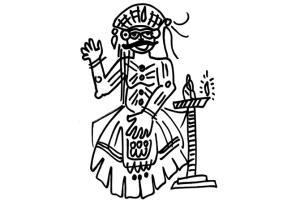
Illustration/Devdutt Pattanaik
%20(1).jpg "Devdutt Pattanaik") As a child in Mumbai, I watched Rajan Uncle perform Chakyar Kootu. My parents were economic migrants from Odisha. My neighbours were from Maharashtra, Kerala and Tamil Nadu. And we got to see cultural performances that no one in Odisha, or Maharashtra, would have had access to, like Chakyar Kootu. With his white painted face, and a golden hat, Raja-appa (as we would call him) would speak in Tamil and Malayalam and I would watch the audience laugh and sneer, late into the night. What are you saying, we asked him. So, for our benefit, he performed once in English. And we realised he was telling stories from the Puranas. But, while he was telling stories, he was also making political, cultural and social comments. Some of them sarcastic. Some cynical. Some mischievous. He told us that this was the performance art of the Vidushaka, the clown, who would convey the people's ire to the king in a fun way.
As a child in Mumbai, I watched Rajan Uncle perform Chakyar Kootu. My parents were economic migrants from Odisha. My neighbours were from Maharashtra, Kerala and Tamil Nadu. And we got to see cultural performances that no one in Odisha, or Maharashtra, would have had access to, like Chakyar Kootu. With his white painted face, and a golden hat, Raja-appa (as we would call him) would speak in Tamil and Malayalam and I would watch the audience laugh and sneer, late into the night. What are you saying, we asked him. So, for our benefit, he performed once in English. And we realised he was telling stories from the Puranas. But, while he was telling stories, he was also making political, cultural and social comments. Some of them sarcastic. Some cynical. Some mischievous. He told us that this was the performance art of the Vidushaka, the clown, who would convey the people's ire to the king in a fun way.
When art is stripped of politics, it is reduced to entertainment for the patron (like apsara dancing for Indra in Swarga) it fails in its very purpose—to elevate the mind and soul (like Shiva dancing before the rishis in the Deodar forest). Its metaphors become more about fantasy and less about reality. In the 19th and 20th century, after systematically destroying the 'devadasi' culture, by equating them with prostitution, dance and music was claimed by the elite society in South India, as a tool to keep alive India's classical tradition, adequately sanitised of all carnal underpinnings, to convey stories of gods and goddesses aesthetically, on stage. They were seen as spiritual, not political. But is that right?
Read Next Story
Trending Stories
Latest Photos
Latest Videos
Latest Web Stories
ADVERTISEMENT
Mid-Day Fast
ADVERTISEMENT

ADVERTISEMENT