






Outside the textbook
Updated On: 03 September, 2023 07:28 AM IST | Mumbai | Sumedha Raikar Mhatre
India’s multi-age mixed-ability alternative schools are few, but fitting retorts to the unjust mainstream institutions premised solely on the idea of passing exams

Listen to this article :
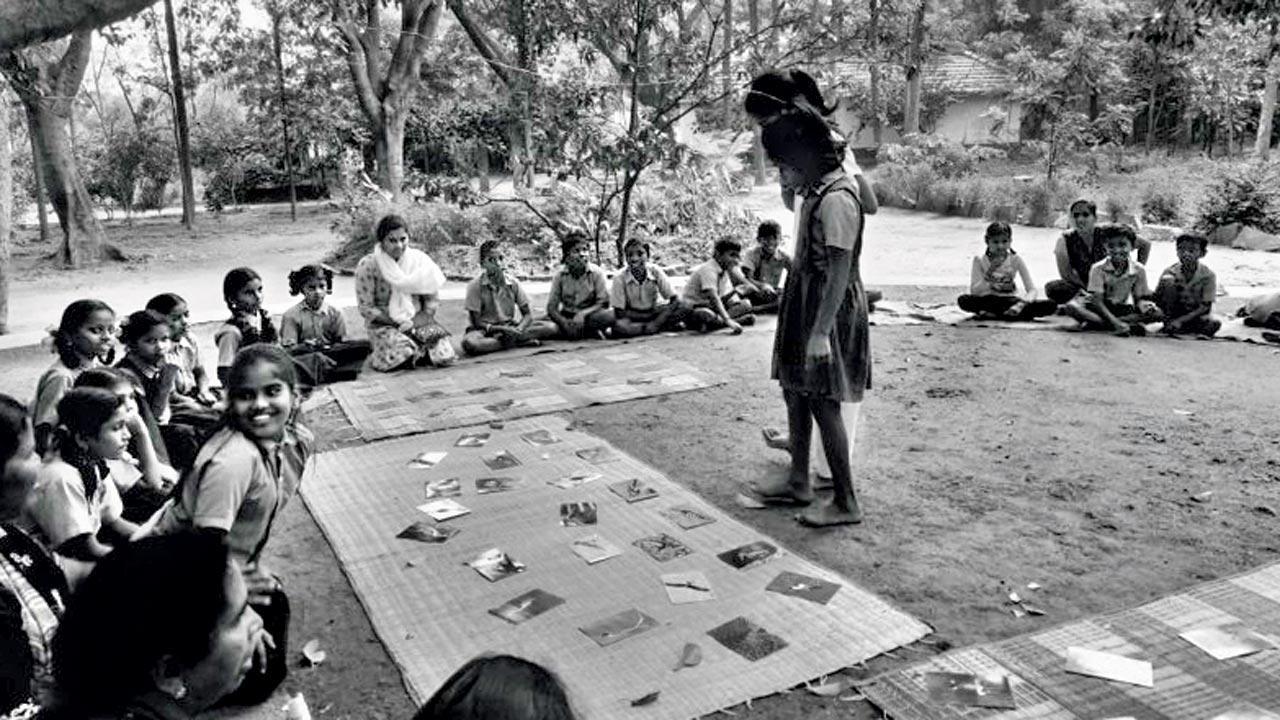
A workshop on bird life with children from the nearby Government Primary School, 2019, in Silvepura. Pics Courtesy/Jyoti Sah
 The coincidence was beautiful, rather educational. Two new books, published by Orient BlackSwan, on true joys of alternative out-of-the-box school education sparked a vivid memory of Hoshangabad, recently renamed Narmadapuram, for me. The pilgrim town, located on the southern bank of the Narmada river flowing through Madhya Pradesh, holds critical importance for the Narmada Parikramavasis. It’s an avenue to visit one of India’s sacred rivers; it’s a point of convergence and therefore, presents a rather sorry congested picture of pilgrims who bathe, wash clothes, clean utensils, store water, and generally throw flowers and other pollutants into the celebrated Sethanighat. It was deeply painful to witness Narmada’s pollution carried out in the name of rituals. Hoshangabad made me wonder as to why Indian pilgrims drown their formative civic classroom lessons in community spaces.
But the same Hoshangabad came alive as a test case of an internationally acclaimed experiment-based science education programme highlighted in two new books. The first, Education, Teaching, and Learning, delineates milestone departures in the discipline of Education in India, much like the Hoshangabad Science Teaching Programme (HSTP) launched in 16 government-run middle schools of Hoshangabad district in 1970. The second book, Un/Common Schooling, focuses on alternative schools founded in India’s remote and marginalised parts, which includes a chapter on the synergy between the Eklavya society and the Madhya Pradesh government in remapping of the existing science curriculum. Both books underline the socio-cultural dimension of science education. They elaborate on multiple field-tests and revisions of the science curriculum spanning over three decades. While writing experiment-based science books forms the core of the project, the HSTP story is more about the joys of collective learning, the idea of treating student-teacher community as a laboratory and training science teachers to be fellow travellers beyond classrooms.
Read Next Story
Trending Stories
Latest Photos
Latest Videos
Latest Web Stories
ADVERTISEMENT
Mid-Day Fast
ADVERTISEMENT

ADVERTISEMENT