Selfie maine le li aaj
Updated On: 26 February, 2023 07:57 AM IST | Mumbai | Paromita Vohra
You could watch movie stars dance in diverse locations and through those images claim those worlds for your own—Kashmir, Holland, Vrindavan Gardens





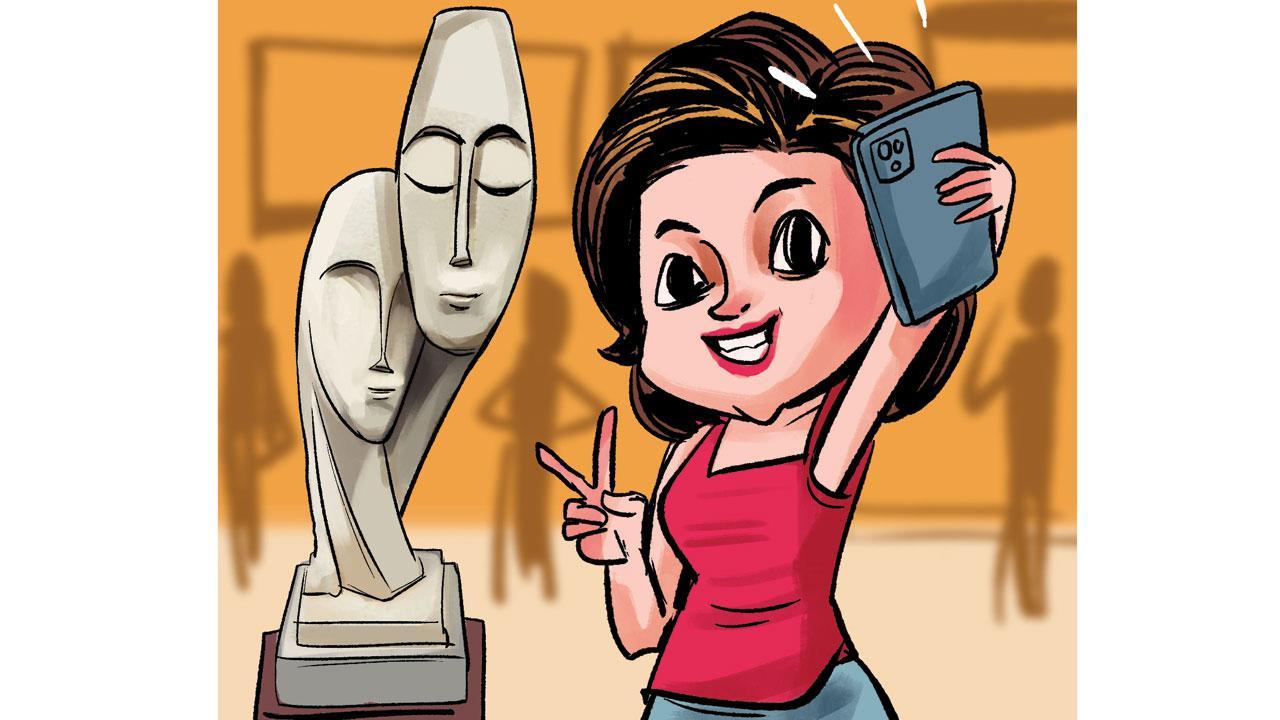
Illustration/Uday Mohite
 Last weekend at the Sassoon Dock Art Festival, a wonderfully diverse crowd thronged the exhibition venues. Almost more striking than the art though, was how most visitors were involved in taking photographs of themselves. Murals, sculptures, photographs, were assessed mostly as backdrops with high-production values for a photograph of the viewer. Where exhibits were in darkened rooms, making self-photography impossible, people compulsively photographed the art works, took videos of videos. It was as if a private, direct relationship with the artwork was somehow awkward. One could relate to it only via a screen. The screen, ubiquitous in our lives, validates reality, almost as if we do not have confidence in our inner selves enough to feel and remember the experience. Well, our inner selves don’t get as much practice as our outer selves.
Humans have searched for their own reflection in art, in gods, in the eyes of a lover. These images were also a conduit to reflect on oneself. People have long stamped themselves onto the world—graffiti on monuments, tourist photos before wonders of the world. If you could not visit the wonder of the world, or ride an airplane, you could get a photograph of yourself within a cutout, or in front of a photograph of the Taj Mahal, joining yourself through images to a long line of lovers, tourists and photographic subjects. You could watch movie stars dance in diverse locations and through those images claim those worlds for your own—Kashmir, Holland, Vrindavan Gardens.
Trending Stories
Latest Photos
Latest Videos
Latest Web Stories
ADVERTISEMENT

Ganeshotsav 2026

ADVERTISEMENT