






The Barbie (political) party
Updated On: 30 July, 2023 07:02 AM IST | Mumbai | Paromita Vohra
Twelve-Step Barbie (Richard Grayson) imagines Dysfunctional Barbie, Reflective Barbie, Litigious Barbie etc—rather like the ones America Ferrara’s character draws for/of herself.

Listen to this article :
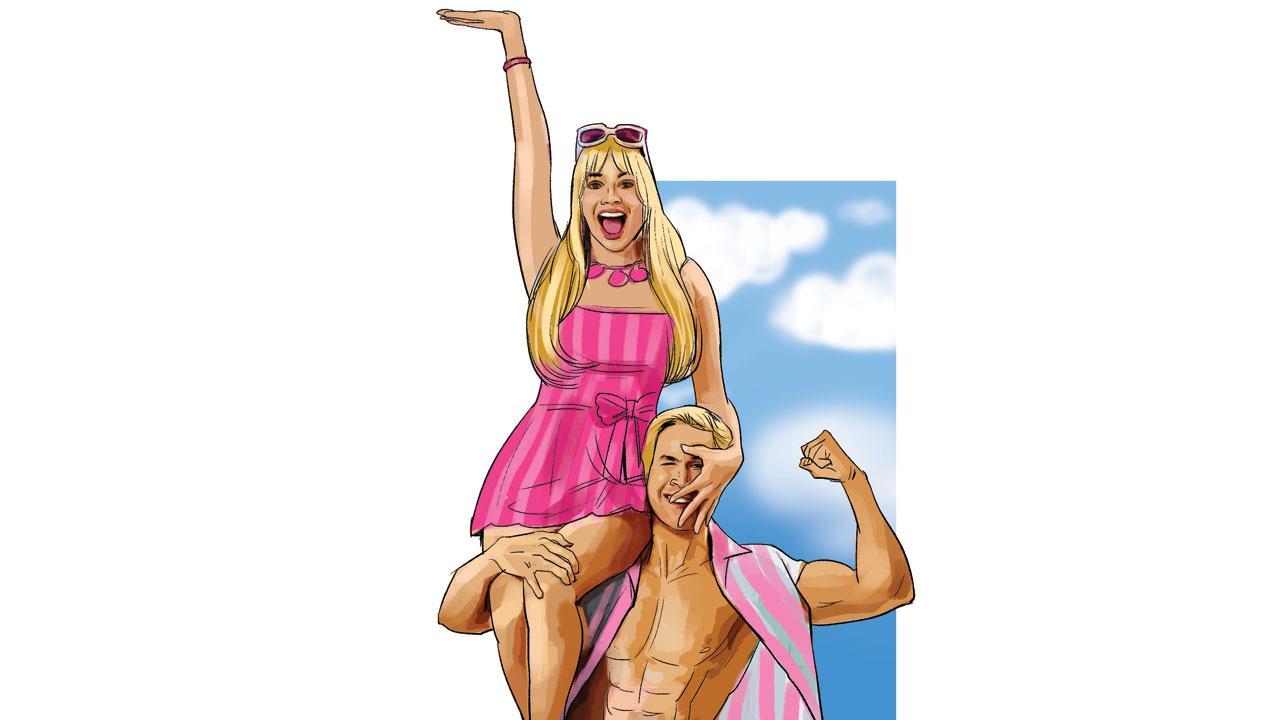
Illustration/Uday Mohite
 To see Greta Gerwig’s new film either as reinventing Barbie or capitulating, holds if the most obvious critique—aka Barbie the pernicious body standard—is your reference point.
The film had me ferreting out my stash of “90s girl books”. I found Barbie, A Life in Fashion: As told to Laura Jacob, a Tiny Folio art book, where the narrator—supposedly Barbie—tells the writer her life-story as a fashion history; a Running Press Barbie postcard book full of arch scenarios featuring Barbies with blurbs. An example: Ken stares blankly ahead. Two Barbies chat. “Wouldn’t the world be perfect if all men were Ken?” “Yes! When you’re tired of one, you can just buy another for $6.99”. This is a familiar feminist pop art style. Outwardly stereotypical femininity is contradicted through wry, witty, scandalous inner thoughts, rolling their eyes at gendered expectations. Mondo Barbie was an anthology of diverse Barbie riffs. In a poem called Kinky (Denise Duhamel), Barbie and Ken exchange heads. Twelve-Step Barbie (Richard Grayson) imagines Dysfunctional Barbie, Reflective Barbie, Litigious Barbie etc—rather like the ones America Ferrara’s character draws for/of herself.
Read Next Story
Trending Stories
Latest Photos
Latest Videos
Latest Web Stories
ADVERTISEMENT
Mid-Day Fast
ADVERTISEMENT

ADVERTISEMENT