






Home / Sunday-mid-day / / Article /
Narendra Dabholkar's son Hamid Dalwai revisits the life of social reformer
Updated On: 24 June, 2018 07:01 AM IST | Mumbai | Kusumita Das
Slain activist Narendra Dabholkar's son Hamid revisits the life of the social reformer he's been named after, Hamid Dalwai, through a film

Listen to this article :
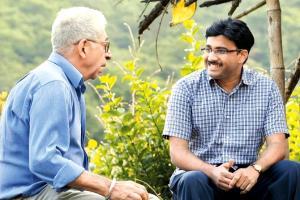
Hamid Dabholkar (right) with actor Naseeruddin Shah who features in the hour-long documentary
It was when Hamid Dabholkar was in Class 3 or 4 in school that he first felt aware of his "Muslim" name. In history text books, while reading about Shivaji's battles against the Mughals, the concept of Hindu and Muslim, at least through nomenclature, started to become clear to children of that age, says Dabholkar, who would get teased by his classmates due to his name. When he told his father, rationalist Narendra Dabholkar [who was assassinated in 2013] about it, he explained to young Hamid that he was named after Hamid Dalwai, the Muslim reformer who later came to be known as the man who started the fight to abolish Triple Talaq in India. "Names have no religion, I was told and that was sufficient for me," Dabholkar tells us. His connection with Dalwai has gone beyond his name over the years. The 39-year-old social activist is now part of a documentary titled Hamid: Unsung Humanist that has been directed by veteran Marathi actor Jyoti Subhash. The film also features her daughter Amruta Subhash and Naseeruddin Shah, besides Dabholkar himself.
Shot in four days, the film traces the journey the trio undertakes to Mirjoli, the village in Ratnagiri, where Dalwai was born. His life is revisited through his family, the people he worked with and his writings. "They have had few interactions, but my father was a distant observer of Dalwai's work. He started the Andhashraddha Nirmoolan Samiti [ANS] 10 years after Dalwai's death, but he was active in the social reformist movement since the 70s itself. I can see strong parallels in their philosophy — my father was also a strong proponent of constructive criticism of religion and constitutional nationalism. Through this film I connected to both Dalwai and my father," Dabholkar says.
Read Next Story
Trending Stories
Latest Photos
Latest Videos
Latest Web Stories
ADVERTISEMENT
Mid-Day Fast
ADVERTISEMENT

ADVERTISEMENT