






Home / Sunday-mid-day / / Article /
A reason to kill
Updated On: 03 October, 2021 07:39 AM IST | Mumbai | Jane Borges
A new book that offers a fresh account of the controversial political assassination of the Mahatma, unearths a complex plot that involves a Partition refugee, a princely state and a Hindu political party

Listen to this article :
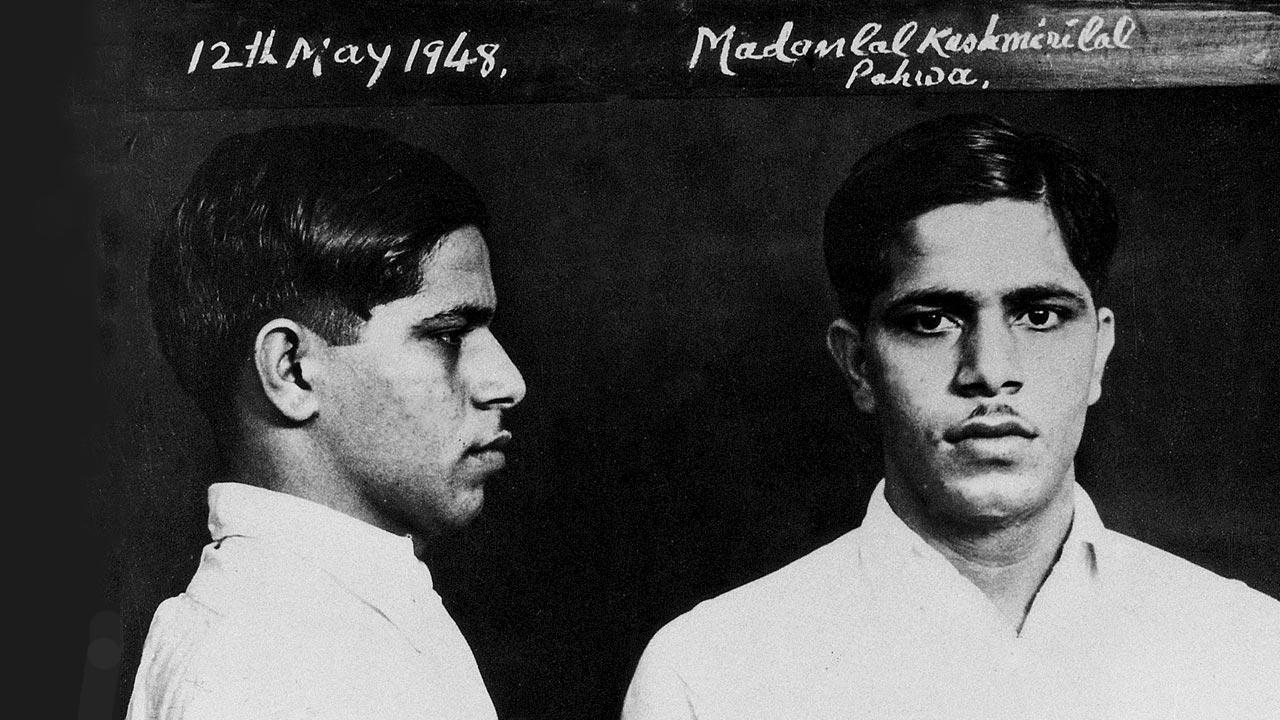
Madanlal Pahwa, a refugee from Pakistan, had made a failed attempt to assassinate Gandhi on January 20, 1948. Pics/Getty Images
History can sometimes be unforgiving. But, more often than not, it is plagued by amnesia. Madanlal Pahwa is a product of this affliction. In Mahatma Gandhi’s assassination story, there appears to be only one anti-hero—Nathuram Godse, the man who pumped three bullets into his frail body at Birla House, Delhi, on January 30, 1948. Only 10 days before this incident, 20-year-old Pahwa, a refugee from Montgomery (today, Sahiwal) in Pakistan, had set off a guncotton slab during a prayer meeting at the same venue, in an attempt to kill the Mahatma. “I think apart from [author] Manohar Malgonkar and [political psychologist and social theorist] Ashis Nandy, who wrote in some detail about Madanlal, his story is relatively unknown. He had witnessed the horrors and violence of the Partition, before he came to Bombay, and became a willing foot-soldier to kill Gandhi,” shares journalist-scholar Priyanka Kotamraju, in a video call with mid-day.
In a new book, The Murderer, the Monarch and the Fakir (HarperCollins India), which Kotamraju has co-authored with investigative journalist Appu Esthose Suresh, the duo shine new light on Pahwa, while also offering a fresh account of the events leading up to one of the most controversial political assassinations in contemporary history. Suresh’s interest in Gandhi began while he was a student at St Stephen’s College, Delhi. The college had a Gandhi Study Circle (GSC), one of the oldest student societies, which he says was “practically defunct” when he joined. “At the time, I remember having only two broad ideas about Gandhi’s assassination—first, that Godse killed Gandhi, because of his pro-Muslim approach. The second, was that RSS [Rashtriya Swayamsevak Sangh] was responsible for the incident,” he says. These ideas slowly evolved as Suresh, who revived the society, came in close contact with other Gandhian scholars and researchers, prompting layered investigations about the leader’s life, including the fact that there had never been any proof to implicate the RSS in his murder.
Read Next Story
Trending Stories
Latest Photos
Latest Videos
Latest Web Stories
ADVERTISEMENT
Mid-Day Fast
ADVERTISEMENT

ADVERTISEMENT