Home / Sunday-mid-day / Article /
This documentary on an Indian Olympian also explores unique stories of partition
Updated On: 28 April, 2024 06:11 AM IST | Mumbai | Sucheta Chakraborty
A daughter’s documentary on her Olympian father becomes a larger story about history, nations, and sport and the bonds that Partition could not break





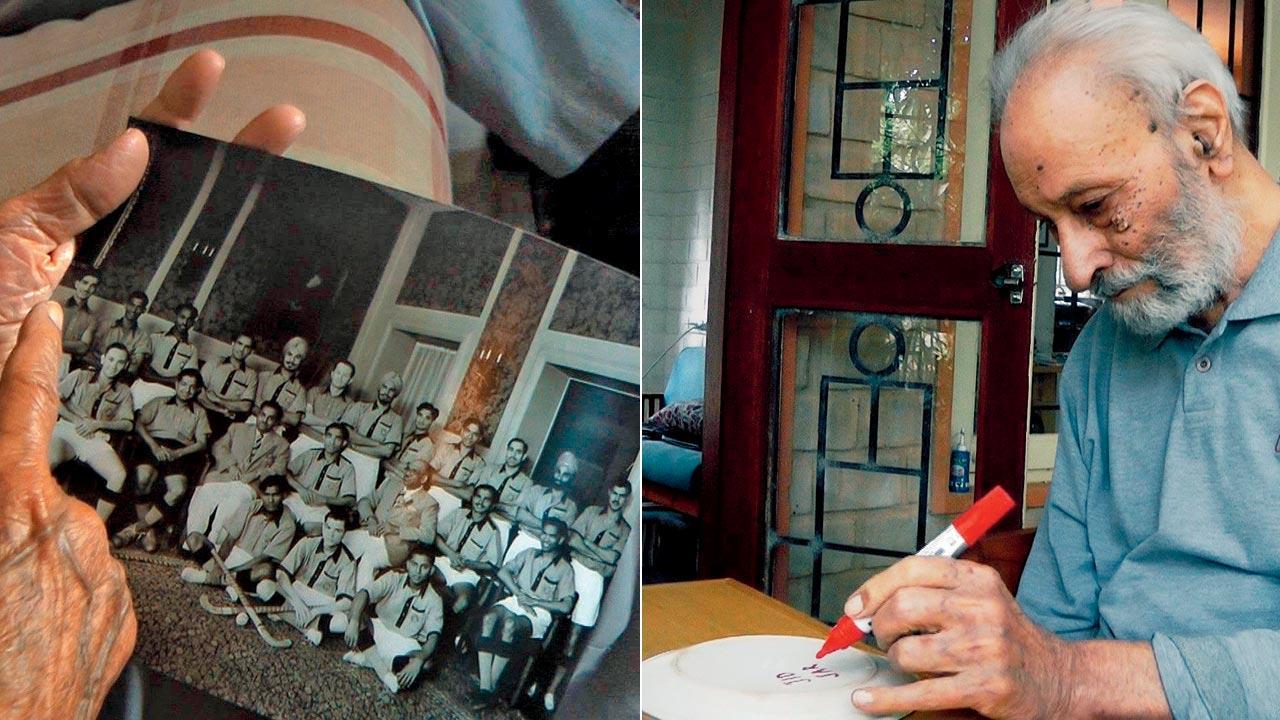
Nandy Singh was a member of the Indian hockey team that won the gold at the ’48 and ‘52 Olympics. He suffered a stroke at the age of 84 and his daughter and filmmaker Bani Singh speaks of recognising the Olympian as she watched her father face his illness with courage and grit. Pic Courtey/Film Southasia and Asia Society India
It's only a 50-minute flight from Lahore to Delhi, but an immeasurable emotional distance. It felt like I went behind enemy lines, but when I found the enemy, he was a friend!” We hear Bani Singh narrate in her 2021 documentary Taangh (Longing), as she flies back from Lahore having met Shahzada Shahrukh, vice-captain of the Pakistan Olympic hockey team of 1948. Singh’s father, Nandy Singh, was a member of the India hockey team that won gold at the ’48 and ‘52 Olympics and the film centres on journeys—both real and metaphorical—into the past that the director takes, traversing a personal history to explore a larger story of Partition, hockey, and the Olympics. “I have seen many films about the Partition where the older generation narrates horrific experiences, and I did not fully connect because it was something that happened a long time ago, and was often so awful and dramatic that you wanted distance from it. And I would feel helpless,” Singh tells us. “In this film, I wanted the daughter to be the voice of the present, engaging with the past so that there can be a conversation. Something came out of that whole interaction that left you with a feeling of joy.” She also points out that the film favoured “the feminine perspective”, and not simply because it was helmed by a woman. While many she worked with felt that the story was just about the Olympic gold, “I [would] tell them that it is also a story about a daughter and father and their relationship, and trying to search for oneself within the identity of your parents, which is a universal story.”
Singh, who studied at the National Institute of Design and worked at the Virasat-e-Khalsa museum in Anandpur Sahib (Punjab) as a gallery visualiser and content interpreter, feels that her newness to film worked in her favour. “What I got from design, which I carried with me, is that I think in layers. So even when I was pursuing the story and had the camera in hand, while things were unfolding, I was seeing that this story had layers,” she observes.
Trending Stories
Latest Photos
Latest Videos
Latest Web Stories
ADVERTISEMENT

Ganeshotsav 2026

ADVERTISEMENT