Home / Sunday-mid-day / Article /
A modern-day version of 'Devdas' raises relevant questions about love, conflicts
Updated On: 30 October, 2022 08:34 AM IST | Mumbai | Sucheta Chakraborty
A modern-day reimagining of Saratchandra’s story of doomed love, set in our turbulent world of ideological and societal clashes, gives voice to its female protagonists while questioning the morality and intent of its much-romanticised ‘hero’





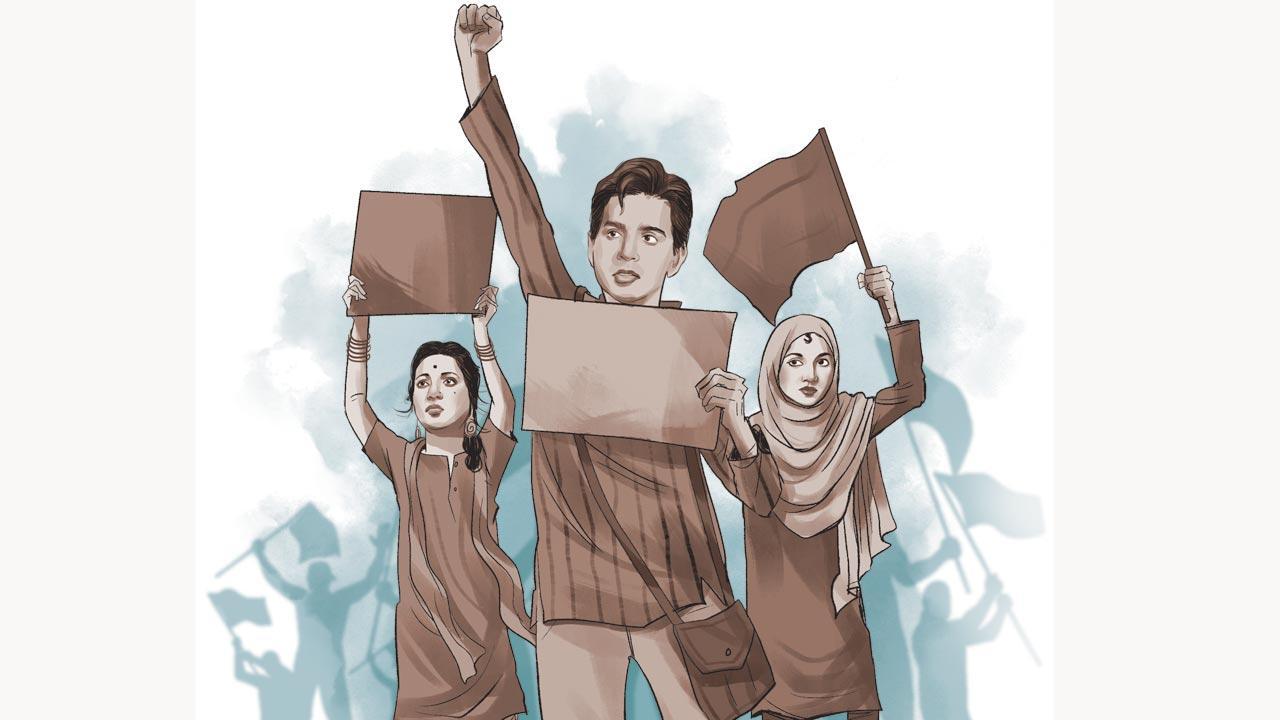
Illustration/Uday Mohite
I was going to write an out-and-out romance but it took its own shape,” author-screenwriter Aayush Gupta tells us about his new subversive contemporary retelling of Saratchandra Chattopadhyay’s Devdas, titled My Name is Not Devdas (HarperCollins Publishers India). The defiance obvious in the title seeps through the text where the name serves not to identify its central male character but to hide his identity. “I gave up the idea of doing it as a faithful adaptation because the original is so good and has everything,” says Gupta, citing its universal themes of death, doomed love and heartbreak as reasons for its multiple adaptations over the years and endless appeal across different generations. Even while adhering to those broad themes, he wanted his version to evoke our fraught present. “I wanted to take the names, wanted to take the basic structure of one guy and two girls and tell a different story set in our times and relevant to our times.”
Gupta’s novel, his second after political thriller, Toppers, finds itself in the volatile student world of university campuses in Delhi where differing political ideologies and caste and class disputes determine and dictate its central doomed love triangle. While a yellowing, stolen library copy of Saratchandra’s Devdas that a character reads in the book sustains the link with the original, Gupta’s retelling places its chief conflict elsewhere. He explains that while in the original, it was external forces such as family and society that doomed Devdas’s relationship with Paro. “Here, the conflict is internal; the focus is on what they believe, what baggage they carry from their places of origin and what political upheavals and migrations they have witnessed.” What differentiates the work from a run-of-the-mill romance, he insists, is the presence of conflicts other than those pertaining to the relationships. “You are fighting one battle with the person that you are in love with, but in reality, there are so many other battles that you are fighting alongside—you are trying to find out who you are and what you believe in. These questions take centre stage in the lives of each of these characters.”
Trending Stories
Latest Photos
Latest Videos
Latest Web Stories
ADVERTISEMENT

Ganeshotsav 2026

ADVERTISEMENT