Home / Sunday-mid-day / Article /
Direct-to-home azaan
Updated On: 15 May, 2022 07:12 AM IST | Mumbai | Jane Borges
While politicos fan hatred, city’s Muslim clerics go about quietly developing sound-light tech that follows noise pollution index and apps to bring muezzin’s call for namaaz to people’s phones





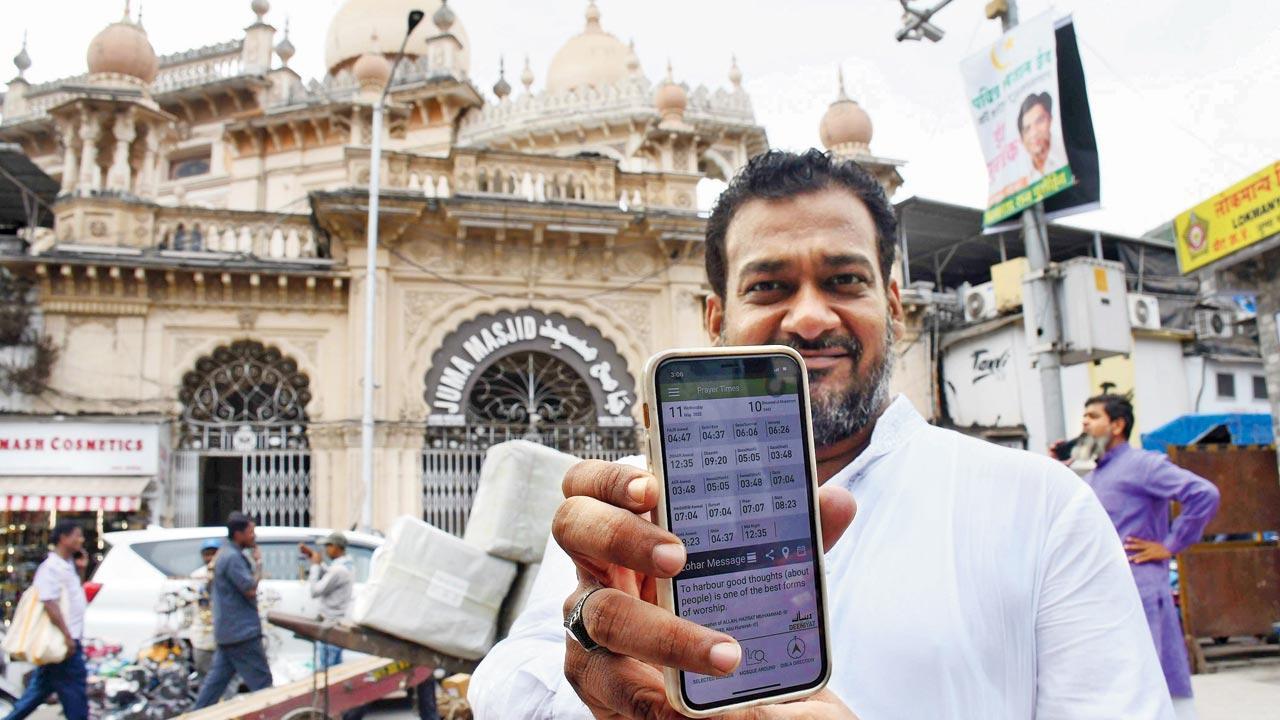
Crawford Market’s Juma Masjid’s trustee Shuaib Khatib is working with techies from Maharashtra College to develop an app based on a model adopted by UK mosques. Pic/Ashish Raje
Stillness is central to prayer. At the over two-century-old Juma Masjid, built over a large water reservoir, this thought was at the heart of its construction. One of the more important religious monuments in the city, which incorporates arabesque art into its design, the masjid wasn’t always surrounded by busy market streets. With Kalbadevi to its right, and the Victorian-era Crawford Market straight ahead, Juma Masjid’s towering minaret has been witness to a sea of change since it was erected in the 1800s. “If you see the old photos of the masjid, you’ll realise that it was staring into a vast open space. There were very few buildings in the neighbourhood and no vehicles at all,” Shuaib Khatib, trustee and chairperson of Juma Masjid of Bombay Trust, tells us over a phone call. The calm and quiet outside not just added to its allure, but also ensured that the azaan—the muezzin’s call summoning Muslims for namaaz—reached far and wide. This was the time when loudspeakers didn’t even exist.
To ensure that the azaan could be heard by the devotees, an acoustical innovation was incorporated into the quadrangular-shaped structure’s architecture. “There were two minars constructed at every corner of the masjid, which created an echo effect [that reverberated any kind of sound],” he shares, adding, “This is why we didn’t need loudspeakers back then.” Khatib, however, clarifies that this would no longer be possible, even though the minars still stand. “The commotion on the streets, and the honking vehicles, will drown the sound of the azaan.”
Trending Stories
Latest Photos
Latest Videos
Latest Web Stories
ADVERTISEMENT

Ganeshotsav 2026

ADVERTISEMENT