






Home / Sunday-mid-day / / Article /
Mumbai: 1980s film club Screen Unit's fascination with Jean-Luc Godard
Updated On: 26 September, 2022 12:09 PM IST | Mumbai | Amrit Gangar
Screen Unit, an eclectic film club from the 1980s, full of young impressionable minds, recalls its tryst with French filmmaker Jean-Luc Godard

Listen to this article :
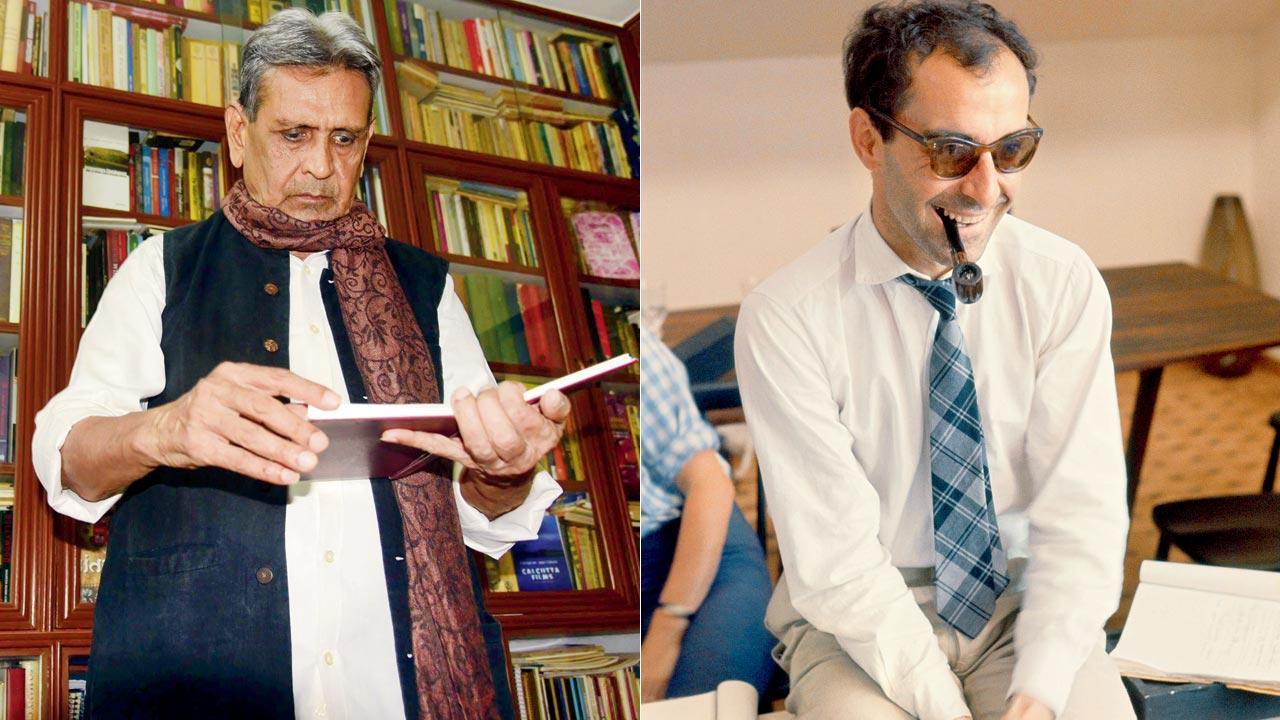
Amrit Gangar was the founder of Screen Unit, a film society that revered Godard for the alternate ways in which he narrated stories. Pic/Atul Kamble; (right) Jean-Luc Godard during the shooting of Contempt in 1963. Pic/Getty Images
The 1980s was an era of retrieval—mostly from the 1960s—be it histories and humanities, arts and arguments, reflections and reverberations. Do not confuse it with nostalgia. In cinematography, it was Jean-Luc Godard (1930-2022) who became a major source of retrieval of iconoclastic inspiration. Screen Unit, a Mumbai-based film club was in its apotheotic enthrallment in the 1980s, and Godard came in with a gusto. The witness to this temporal phenomenon was SU’s mimeographed (cyclostyled) programme notes that were replete with the Godardian presence. In mid-July 1986, five of the French master’s iconic films were screened, one of which was the 1965 anthology film Paris vu Par (Paris seen by…) comprehending six perceptions of Paris by six different directors including Jean-Luc Godard. Much later, such an anthology film was made on the city of Mumbai, Bombay Talkies (2013), which included four well-known Bollywood filmmakers including Anurag Kashyap.
True to its applied philosophy, Screen Unit, active from 1976 to 1998, always preferred to remain small in terms of its membership, but not in the intensity and youthfulness of its programming, analysis and interpretation. A warm reception to JLG was absolutely natural, his defiance of the orthodoxy and formal rigidity struck a chord with our young minds. The programme notes quoted Godard of the 1960s, “Frequenting cine clubs and the cinematheque was already a way of thinking cinema.” To my knowledge, not many film clubs in India were fond of showing JLG’s films as they found his narratives much too fragmentary, non-linear, unconventionally political and hence, not easy to comprehend. In SU’s collective pool of young minds, JLG found a comfortable groove through his provocative aphorisms he spoke and his characters uttered often as his alter-ego. JLG infected many a young cineaste in this country with his thoughts and practice of filmmaking which, for him, wasn’t too compulsive as we might have presumed. The mimeographed programme note recalled him, “You can’t write a book like Ulysses every two years.”
Trending Stories
Latest Photos
Latest Videos
Latest Web Stories
ADVERTISEMENT
Mid-Day Fast
ADVERTISEMENT

ADVERTISEMENT