Home / Sunday-mid-day / / Article /
This exhibit in Mumbai aims to decode the meaning of 'feminine gaze'
Updated On: 27 October, 2024 09:54 AM IST | Mumbai | Debjani Paul
A new exhibit tries to decode the meaning of the “feminine gaze”, keeping the focus on the body—that should be represented, not fetishised



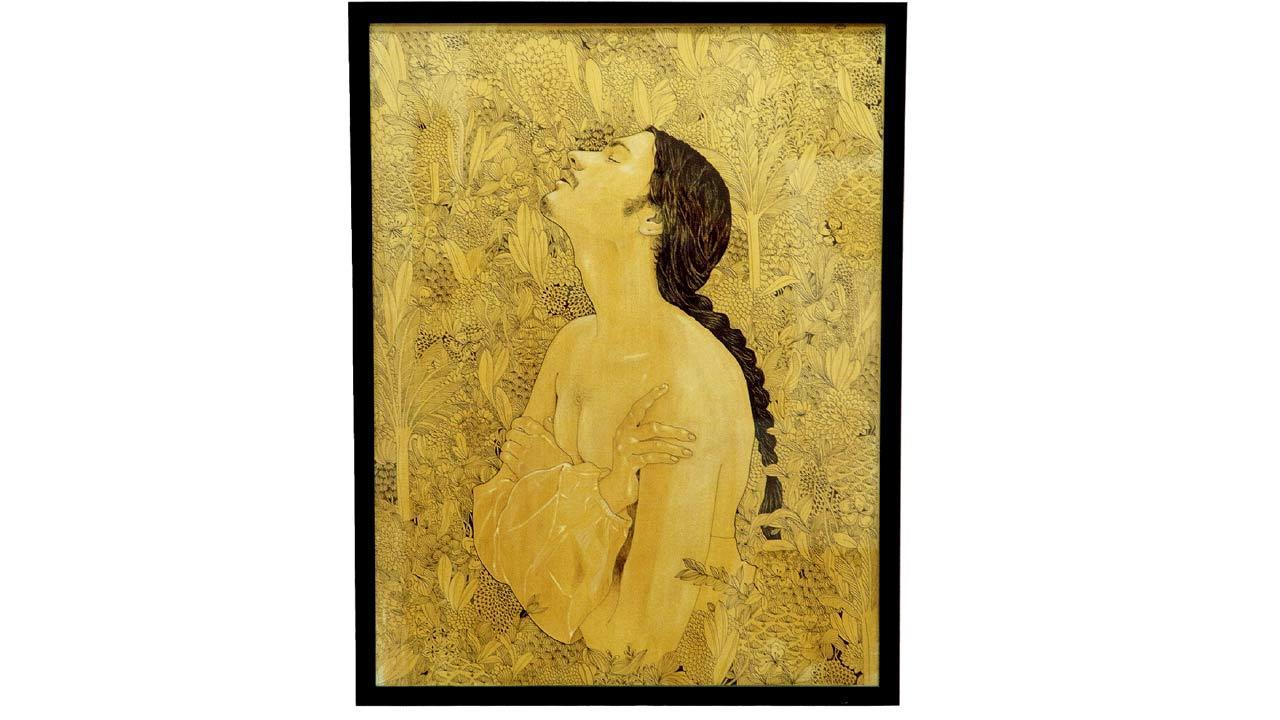
Among the 11 artists featured in the exhibition is Geet Jangid, who presents a queer perspective. This self-portrait, titled Becoming One (pen on tea-toned paper), is a commentary on how the male gaze can be engaged with and what is what is seen as desirable by society
Women grow up experiencing the “male gaze” all through their lives, whether it’s in everyday interactions or in art. In art, it was British film theorist Laura Mulvey who, in her 1973 essay Visual Pleasure and Narrative Cinema, pointed out how women are depicted through a voyeuristic and often erotic lens, reducing them to objects or a mere fantasy for the viewer’s pleasure. From the famed 16th-century Venus of Urbino painting—which depicts a young bride in the nude, reclining on a bed while seductively holding the viewer’s gaze—to the modern-day Wonder Woman, who is skimpily clad compared to her male superhero peers, Mulvey’s words ring true to this day: “Male gaze projects its fantasy onto the female figure, which is styled accordingly”.
A new exhibition at Colaba’s Apre Art House explores how contemporary Indian artists are shifting the perspective from that of objectification to empowerment. The exhibit, titled Alternate Gaze, features artwork by 11 artists—both men and women—across several media, such as photography, sculptures and paintings.
Trending Stories
Latest Photos
Latest Videos
Latest Web Stories
ADVERTISEMENT
Mid-Day Fast
ADVERTISEMENT

ADVERTISEMENT