









Home / Sunday-mid-day / / Article /
How technology can go a long way in ensuring road safety
Updated On: 30 January, 2022 08:18 AM IST | Mumbai | Anju Maskeri
The project head of Road Safety 2.0 talks about why incorporating technology into road safety might just be easier now than a decade ago

Listen to this article :
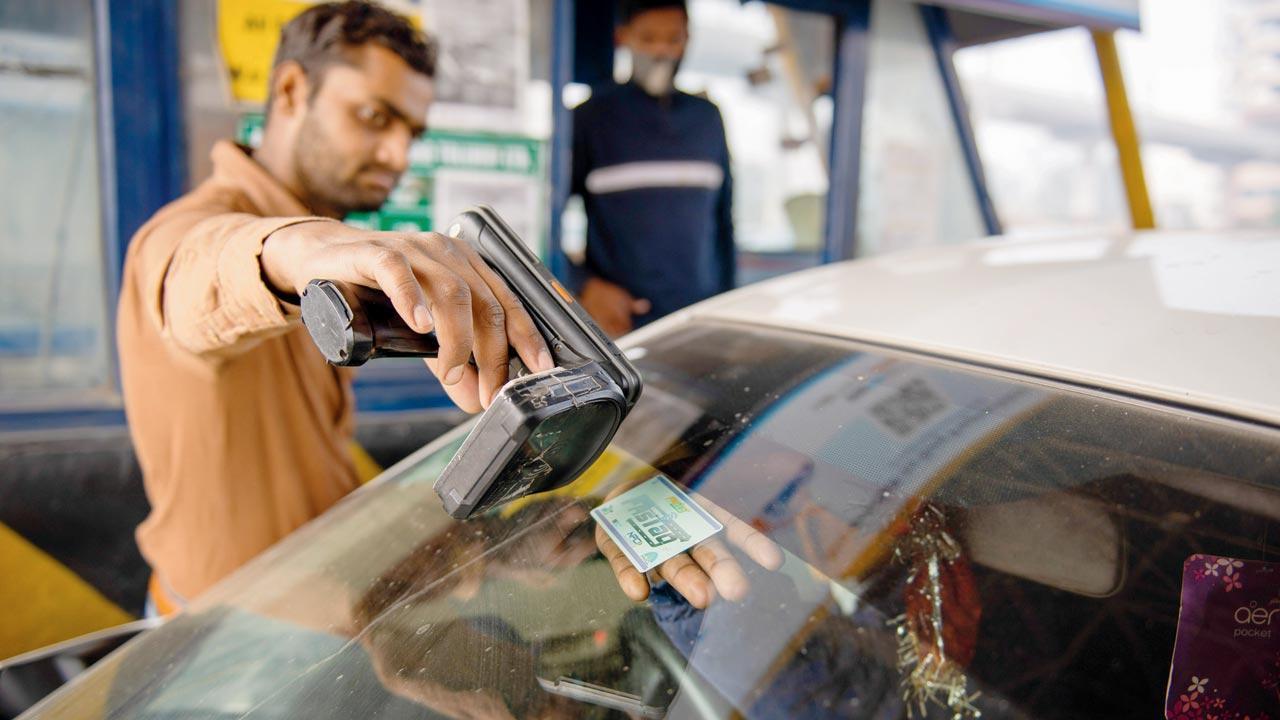
A man scans a FASTag pass at the Khatela Sarai toll plaza. Pic/Getty Images
Each time Akhilesh Srivastava sees vehicles cruising past toll gates using the FASTag corridor, his eyes light up. It’s not only because the sticker that uses RFID (Radio Frequency Identification) technology, stuck on windshields, has reduced the waiting time at booths, but also because it has helped the government save Rs 20,000 crore per annum on fuel. It has also brought in additional revenue totalling Rs 10,000 crore. During his tenure as the Chief General Manager of NHAI (National Highways Authority of India), Srivastava’s foremost contribution was creating and developing this innovation. The civil engineer from IIT and former COO of Indian Highway Management Company Ltd is considered one of the most tech-savvy bureaucrats in the system. Srivastava, however, wears his scholarship lightly. “I joined the government services because I wanted to influence change and modernisation. Even as a junior engineer, I would perennially think about how we could use technology in the smallest transactions,” he says. His AI-based Data Lake for NHAI, a centralised repository that allows you to store all your structured and unstructured data at any scale, served as the blueprint for the recently launched Gati Shakti programme, a digital platform to bring 16 ministries including the Railways and Roadways together for integrated planning and coordinated implementation of infrastructure connectivity projects.
Srivastava has now trained his lens on a more pressing and lethal problem: road accidents. He has been roped in as the Project Head of Road Safety 2.0, an associated initiative with the World Economic Forum. The objective is technology adoption into all four Es of road safety—Education, Engineering, Enforcement and Emergency Care. As per a World Road Safety report from 2018, India is on the top of the list of 199 countries in number of road fatalities, with 11 per cent of the global road fatalities taking place in India alone.
Read Next Story
Trending Stories
Latest Photos
Latest Videos
Latest Web Stories
ADVERTISEMENT
Mid-Day Fast
ADVERTISEMENT

ADVERTISEMENT