Home / Sunday-mid-day / Article /
‘I long to see the student before me’
Updated On: 23 May, 2021 10:03 AM IST | Mumbai | Sucheta Chakraborty
It’s been a year like no other for Kathak exponent-choreographer Kumudini Lakhia, who beat COVID at 91 and made peace with virtual drawing room dance lessons. Aching to return to her dance school, she says large empty spaces offer a dancer energy that’s irreplaceable





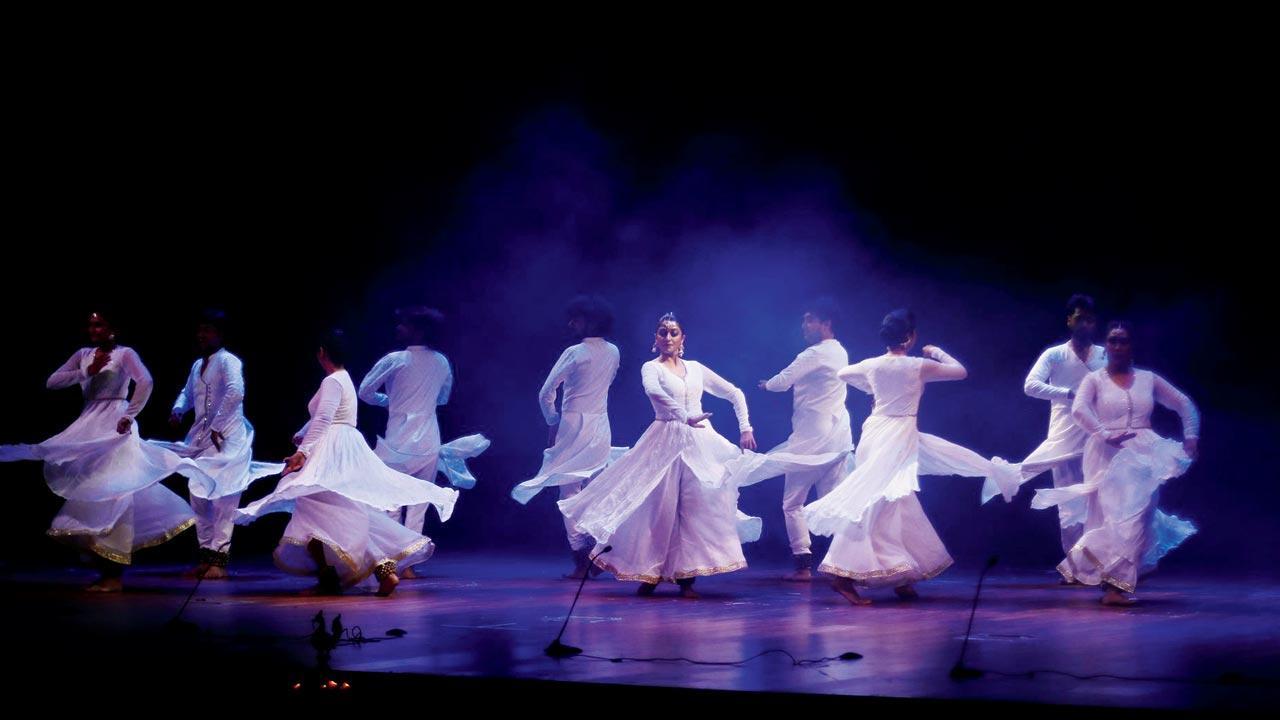
Lakhia started the practice of making her performers wear white on stage, not seen before in Kathak performances, and insisted on neat hairdos and minimal ornamentation on the dancer’s body. Pics Courtesy Kadamb Centre For Dance
Next month, Kumudini Lakhia will be conducting an online workshop on abhinaya or expression, an aspect of dance that she feels cannot be taught. The dancer must lend a personal experience of joy and pain to the performance for the expressions to feel authentic. Lakhia like so many classical exponents has worked to adapt to the online format in the past year, holding virtual sessions like these, though she is far from getting comfortable with it. “I belong to the old school and like to have the student before me,” she says over the phone from her home in Ahmedabad, admitting to how much she has missed teaching in person. Lakhia, who turned 91 last week, continues to make the rounds of her dance academy, Kadamb. Unlike there, abhinaya is difficult to explain online. “People live in small spaces. You start teaching and suddenly you see a bed or a dining table getting in the way. It’s distracting. To be able to give, which you have to in abhinaya, you need empty space around to draw energy from,” she explains.
Lakhia recently recovered from Covid-19. “My doctor called me a fighter,” she says. “To survive a Covid attack at my age is not unusual, but my blood was clotting,” she explains, pointing out that this last bit had her doctors fairly worried for a while. “But I have recovered completely and am fit again,” she reassures.
Lakhia is well-known for her abstract choreographies, focused on conveying moods rather than stories. She traces her earliest inspirations for this style to painting, architecture and poetry. She credits artists like MF Husain and VS Gaitonde, her interest in the ways in which architects used shapes and space, and her frequent visits to the National Institute of Design (NID) to pore over books on woodwork and carpentry. “When I was learning, everything was about Radha-Krishna, Shiva-Parvati, Ram-Sita. But there are other people in the world too!” she laughs. Tired of the religious themes that dominated the compositions of the time, Lakhia broke away towards a more abstract style that absorbed varied artistic influences, designing simple costumes in earthy shades and minimal jewellery, and having music director Atul Desai compose especially for her. One of the first pieces she choreographed was Dhabkar (Pulse) for a performance in Delhi, where her dancers and the musicians wore white, highly unusual for the time, and performed on different levels on the stage playing with perspective. “That was my first attempt to get around the format of a [classical] dance form and design it for my own imagination,” she says.
Trending Stories
Latest Photos
Latest Videos
Latest Web Stories
ADVERTISEMENT
Mid-Day Fast
ADVERTISEMENT