






Home / Sunday-mid-day / / Article /
'Want to have every single building in Parsi Colony sketched for archival value'
Updated On: 14 February, 2021 06:52 PM IST | Mumbai | Jane Borges
A Dadar Parsi Colony resident’s four-year-old attempt at using photos, anecdotes, municipal records, memories and sketches to the iconic neighbourhood in a book speaks of public participation in conserving the cityscape.

Listen to this article :
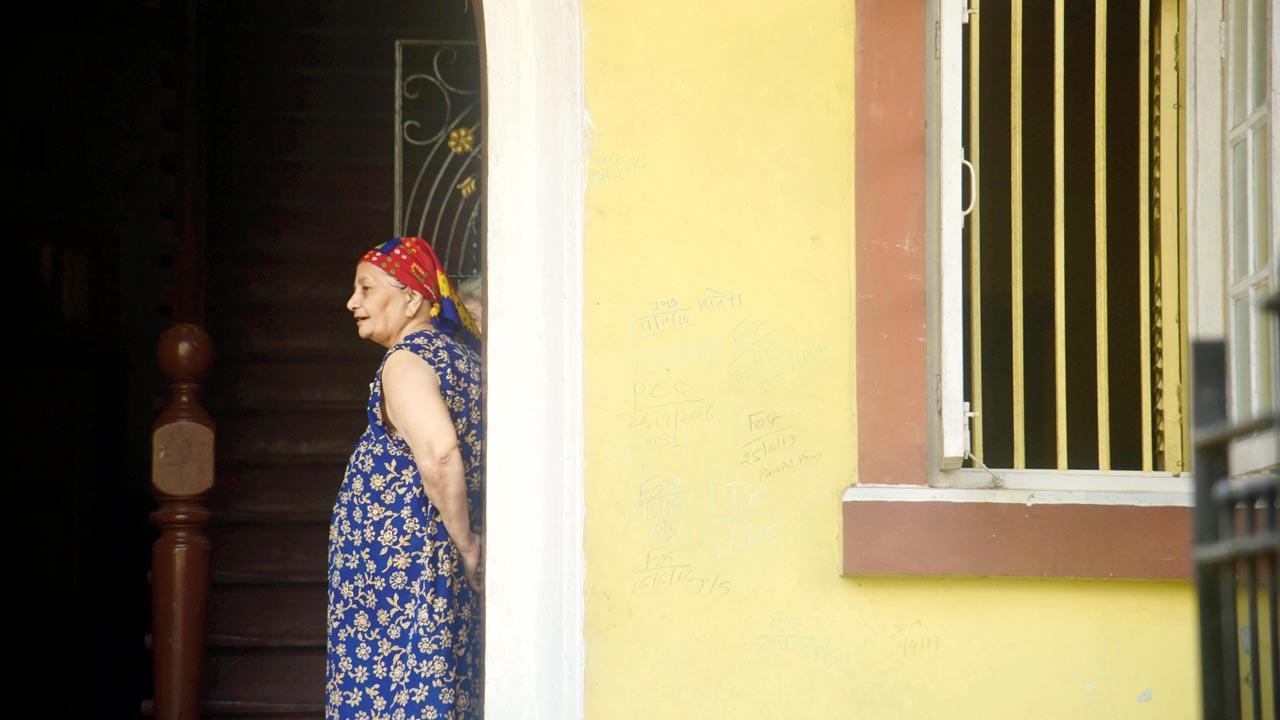
An elderly resident seen outside her home at Mancherji Joshi Parsi Colony, a century-old residential enclave, which was built in the aftermath of the bubonic plague to decongest the over-crowded islands of Bombay. Pic/Atul Kamble
At 9 am, Kayomi Engineer is already out and about. She has just finished taking photographs on her phone, when we meet her at the police chowkie near Five Gardens, Dadar Parsi Colony. Six of these images, which include early morning scenes from the neighbourhood, immediately make it to the Instagram handle @mancherjijoshiparsicolonydadar. Since 2017, the social media account has been the mainstay for news and picturesque views of the enclave, fondly known as DPC among locals. Home to nearly 5,000-odd residents—99 per cent of whom, she says, belong to the Zoroastrian community—the “residential estate” will soon be the subject of a book penned by Engineer. It’s a 21-year-long dream, she says, as she walks us through the precinct, situated in F North Ward.
The idea for the book took concrete shape sometime after Engineer, who formerly worked as administrative director of the Kala Ghoda Association (KGA), started her Instagram account. “It’s something I created on an impulse, kicking around a football with our daughter. A user-friendly online platform to educate publicly, the larger essence of what this locality stands for, to us as residents and to Mumbai. I realised that many residents didn’t have old photographs of the colony, because nobody had really gone around photographing the locality. So, it was an attempt to document and archive the place, too. I did not anticipate having 1,200-plus followers organically.” That was a huge motivation, she adds. Having worked on restoration projects while at the KGA, and being given the rare opportunity to play “understudy” to leading conservation architects such as Vikas Dilawari, has also bolstered her to apply for a UNESCO accreditation for the enclave. Initially slated for release in November last year, research for the book hit a roadblock due to the lockdown. But Engineer feels that putting timelines to a work like this —one that has not been attempted before—would be unfair. “I invest time and effort on working with details, because the book is a one-time project that I have embarked upon, and I might as well ace it.”
Read Next Story
Trending Stories
Latest Photos
Latest Videos
Latest Web Stories
ADVERTISEMENT
Mid-Day Fast
ADVERTISEMENT

ADVERTISEMENT