Home / Sunday-mid-day / Article /
Keeping an ancient tradition alive
Updated On: 05 December, 2021 09:02 AM IST | Mumbai | Sucheta Chakraborty
As a music festival in the city celebrates guru-shishya parampara, we ask if students today can be bound by ties of obedience, devotion and spirituality, adapted to the age of online classes and electronic tanpuras?





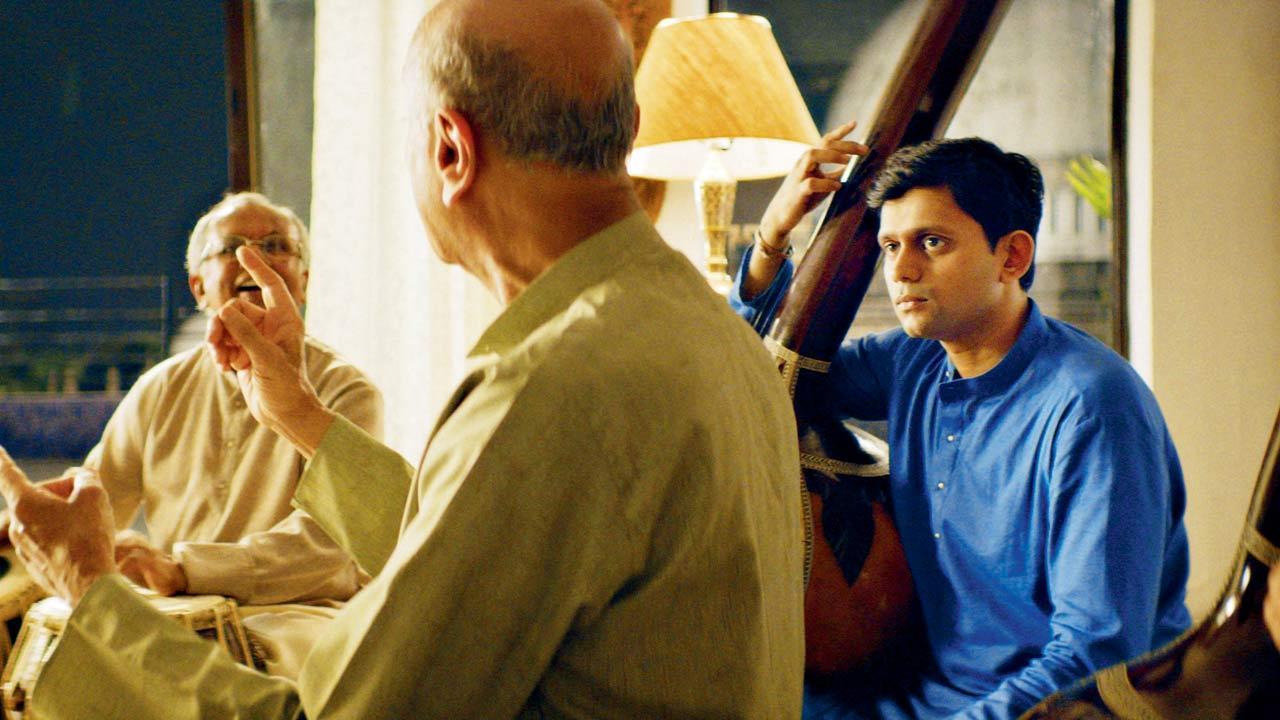
Chaitanya Tamhane’s film The Disciple probed themes of devotion, spirituality, learning and performance through the character of a classical singer, presenting his relationship with his guru and later his pupils
This weekend saw the start of the 11th edition of the National Centre for the Performing Arts’ (NCPA) and Citi India’s Aadi Anant: From Here to Eternity festival in Mumbai. The celebration, opened by renowned sitar player and Grammy-nominated artiste Shujaat Khan, who designs his performances around a rendition of the classical art form that he has grown up within, with Sufi and folk elements, will also host performances by Carnatic vocalist TM Krishna and his troupe, and Shantanu Moitra, Ani Choying, Kaushiki Chakrabarty and others in January. The festival, originally a travelling event, is limited only to Mumbai this year given pandemic restrictions, and is part of a larger programme run by Citi and the NCPA to celebrate the guru-shishya tradition, focused on a relationship of devotion, obedience and spirituality in the passing on of knowledge from the guru to the disciple.
Dr Suvarnalata Rao, musicologist, trained sitar player and head of Indian music programming at the NCPA, speaks of a predominantly oral and aural tradition in Indian music that has come to us through the guru-shishya tradition, the emphasis being on performing and listening rather than writing down, thereby making this kind of mentorship vital and allowing for an unbroken transference of knowledge through centuries. Even within the Indian musical tradition’s stringent grammar, it has left the space open for interpretation, she says.
Trending Stories
Latest Photos
Latest Videos
Latest Web Stories
ADVERTISEMENT

Ganeshotsav 2026

ADVERTISEMENT