Home / Sunday-mid-day / Article /
‘Many cab drivers said that they “worship” their taxis. Is this religion?’
Updated On: 30 July, 2023 07:21 AM IST | Mumbai | Jane Borges
A new, fascinating volume of essays explores how people make sense of their religions in the fast-changing city of Mumbai, whether in a chawl, high-rise or kaali-peeli





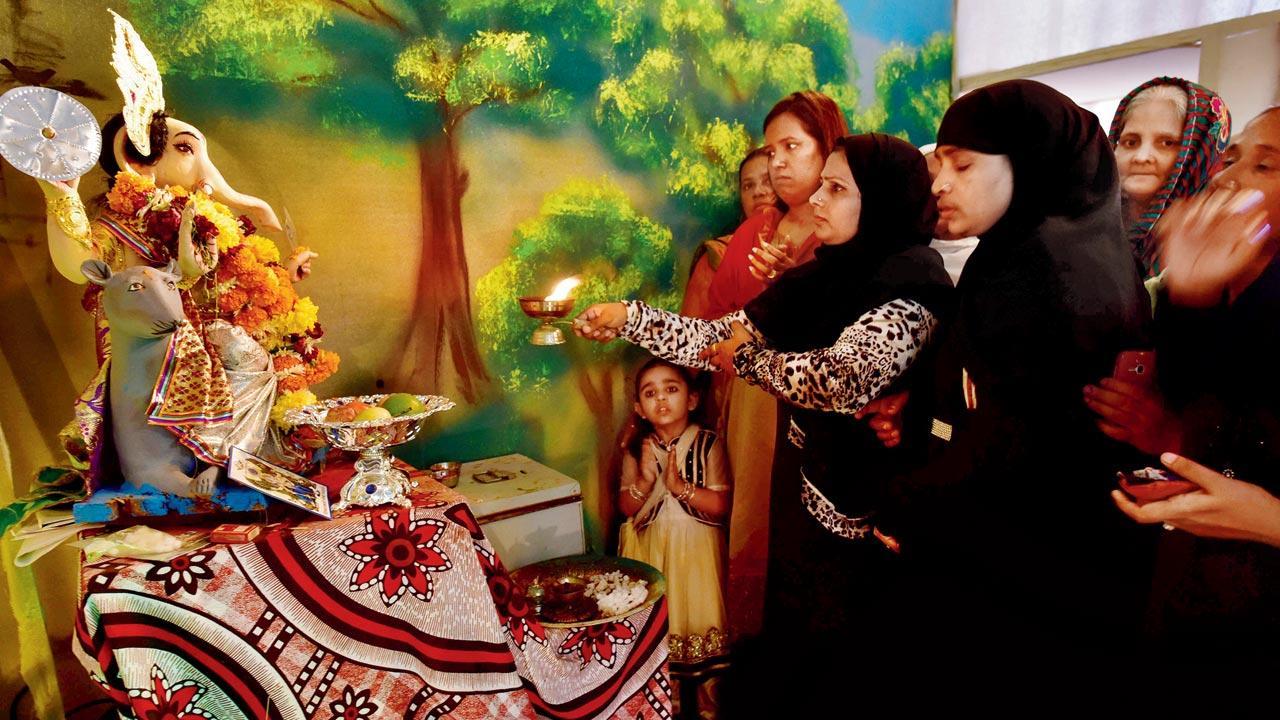
While it is widely known that Muslims participate in Ganpati utsav, a chapter in the book compares how the engagement is different in Bhendi Bazaar and Govandi. “In Govandi, the lower-class are forced to forge social and political connections, to engage with the festival in some ways. New high-rise buildings and gated communities in Bhendi Bazaar detach higher-class residents from the hustle and bustle of the festivities,” Michael Stausberg says. Pic/Getty Images
Michael Stausberg’s relationship with Mumbai has been evolving. The scholar, who teaches at the University of Bergen, first came to Mumbai, then Bombay, in 1991, as a graduate to study the Parsi community. It became his ticket to the city and its history, one that he says he immediately fell in love with. “I was here when Rajiv Gandhi was assassinated near Madras [Chennai]. Mumbai was put on hold for several days.” In retrospect, he says, 1991 was the year when major changes began to stir, transforming both, India and its financial capital. “Many more trips would follow. The religious environment of the city beyond the microcosmos of the Parsi community held a vague fascination for me ever since my first visit, and the Parsis made me interested in Shirdi’s Sai Baba, who is something like a signature saint of the city. Eventually, I came to know academics who were researching other communities.”
Stausberg’s new book, Religions, Mumbai Style: Events-Media-Spaces (Oxford University Press), is a result of this cooperation with over 10 experts from India and abroad, illustrating how people make sense of their religions, and create a religious identity while engaging with the challenging urban environment of their city.
“The most intuitive way of portraying the religious life of any city is to sketch different communities. In fact, several chapters in this volume show that groups that look homogenous on the outside are far more contradictory from the inside. Ganapati Utsav and Muharram are examples of ‘events’. Mumbra and the Sai Baba shrines are examples of ‘spaces’. In the ‘media’ segment, a piece analyses the activities of the World Islamic Network, which broadcasts content addressed to the Twelver Shia Muslim audience, but also reaches out to wider non-Muslim audiences.”
Trending Stories
Latest Photos
Latest Videos
Latest Web Stories
ADVERTISEMENT

Ganeshotsav 2026

ADVERTISEMENT