Home / Sunday-mid-day / Article /
Miss Universe
Updated On: 24 July, 2022 07:36 AM IST | Mumbai | Yusra Husain
Integral to the team behind stunning images of the universe taken by the James Webb Telescope is an Indian scientist whose tryst with space research began in the backyard of her ancestral home in Lucknow





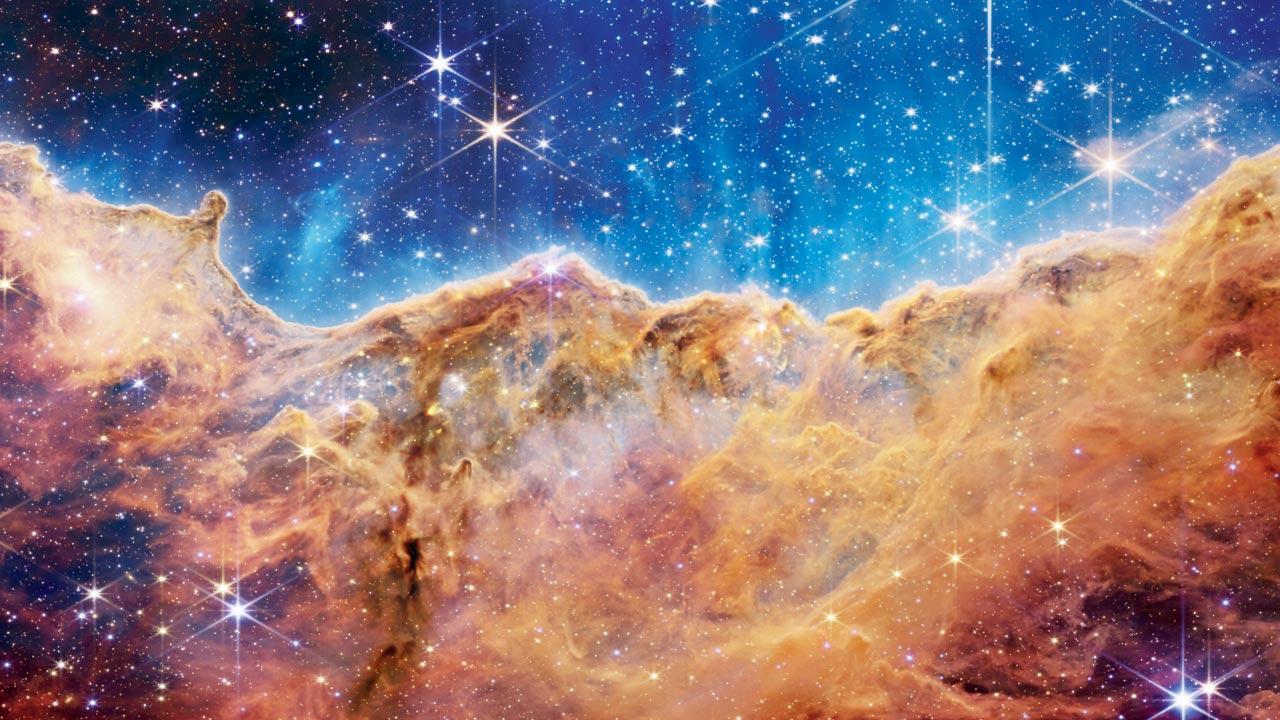
In this handout photo provided by NASA on July 12, 2022, a landscape of mountains and valleys speckled with glittering stars is actually the edge of a nearby, young, star-forming region called NGC 3324 in the Carina Nebula. Captured in infrared light by NASA’s new James Webb Space Telescope, this image reveals for the first time previously invisible areas of star birth. Pic/Getty Images
Her two pigtails dangling to the sides, Dr Hashima Hasan, who was still a preschooler then, remembers tip-toeing behind her grandmother to the backyard of their home in Hazratganj, Lucknow, on the warm night of October 4, 1957. The Soviet Union had launched its first artificial satellite, Sputnik I, and her grandmother had assured her a sighting. To this day, Hasan can recall how the Sputnik I shot like a star in the sky, leaving behind a glittery tail. It was a moment cast in history. Little did she know then that she would someday redefine the way we see the universe.

A young Dr Hashima Hasan, now Deputy Programme Scientist on the James Webb Telescope, worked at TIFR and Bhabha Atomic Research Centre in Mumbai in the 1980s
Trending Stories
Latest Photos
Latest Videos
Latest Web Stories
ADVERTISEMENT
Mid-Day Fast
ADVERTISEMENT