






Home / Sunday-mid-day / / Article /
‘Munawar didn’t want to be just a Muslim comic’
Updated On: 07 February, 2021 07:59 AM IST | Mumbai | Aastha Atray Banan
He may have been given interim bail for now, but what happened to Munawar Faruqui could have changed him forever. What was he like before he headed to Indore for that fateful show? Friends and colleagues speak of a sensitive, and street smart hustler with a fondness for Dilli ka khana

Listen to this article :
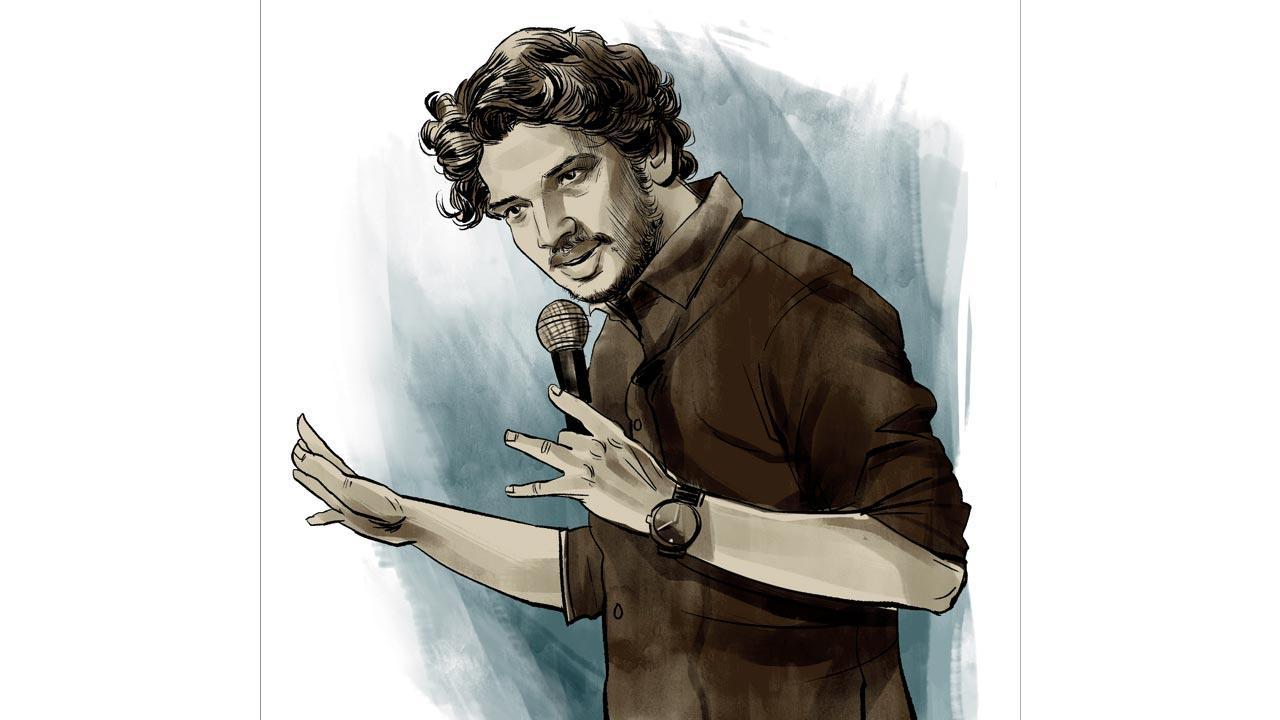
Illustration/Uday Mohite
Before he got into trouble in Indore for allegedly making a joke about Hindu deities, comedian Munawar Faruqui was living a regular life in Mumbai. A resident of Dongri at first, and then Virar, Faruqui had been dabbling in comedy since 2018. Originally from Junagadh in Gujarat, where his home was burnt down during the Godhra riots, he came to Mumbai to live with his father’s sister in 2012. He had lost his mother early on, and his father who came to stay with him later, also passed away in 2020. “He didn’t have lofty dreams. He just wanted to make some money,” says friend and fellow comic, Sagar Punjabi. And, he did it by working at a utensils store, where was paid R60 for a 13-hour shift. While he sent most of the money home, he used his meagre savings to do an online graphic design course.
But, it was comedy that attracted him the most. “He just wanted to tell his story—from Junagadh to Dongri, to whatever happened later. He wanted to talk about things that could only happen in Dongri and Junagadh, because they don’t happen anywhere else. I don’t think he ever thought about offending anyone,” says another friend and comic, Saad Shaikh. No wonder Faruqui’s most popular set was called “Dongri to Nowhere”. Shaikh, who met Faruqui in 2018 at an open mic in Andheri, which was only the second time they were both going on stage, says they both connected, because their material centered around the “mundane problems of Muslims.” “You know, things like what’s the pressure around getting married. In Muslim households, the struggle starts early on. We used to talk about all that. With Munawar, what worked was also that, unlike me—a man who has a beard and wears a kurta on stage—he didn’t really look Muslim,” he recalls of the open mic, where he and Faruqui were also the only two Muslim comedians on the roster.
Read Next Story
Trending Stories
Latest Photos
Latest Videos
Latest Web Stories
ADVERTISEMENT
Mid-Day Fast
ADVERTISEMENT

ADVERTISEMENT