Home / Sunday-mid-day / Article /
‘Not my job as author to tell you what truth is’
Updated On: 03 September, 2023 06:40 AM IST | Mumbai | Jane Borges
Amish Tripathi and Bhavna Roy’s traditional but eclectic upbringing led them on the path of collaboration, and their latest is a book on idol worship





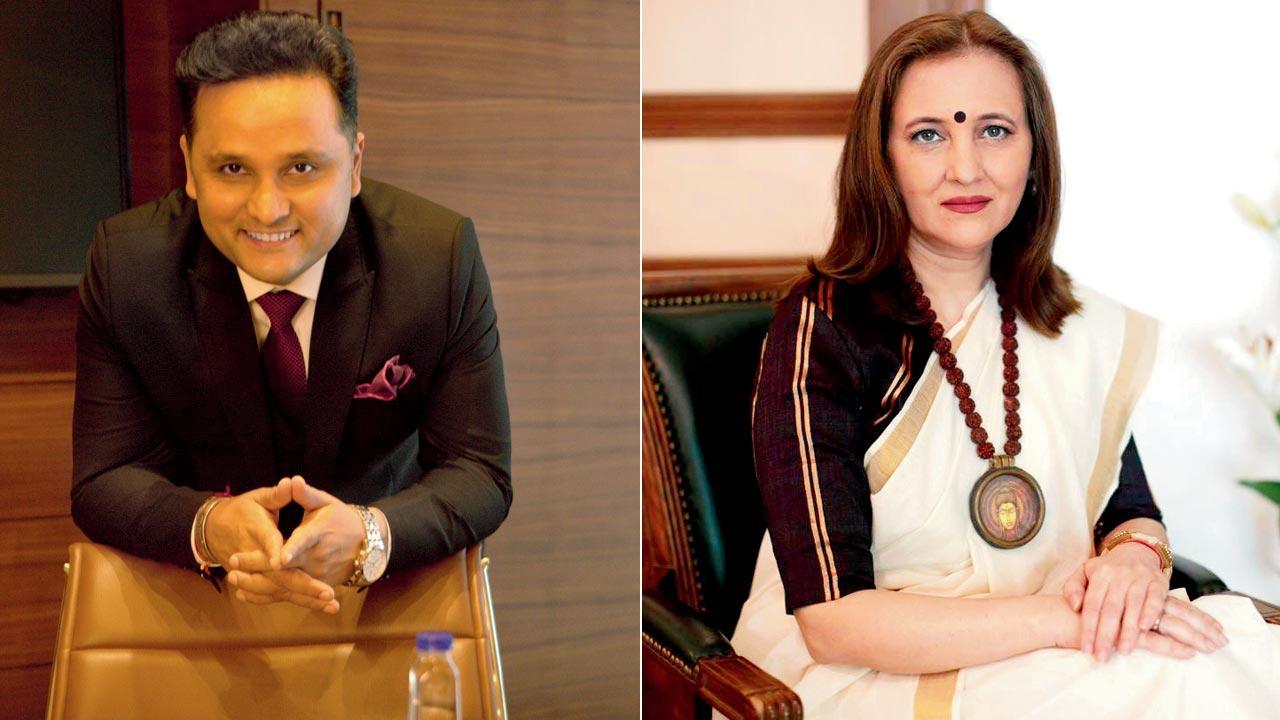
Amish Tripathi and Bhavna Roy
For siblings Amish Tripathi and Bhavna Roy, home was the place that expanded their worldview. “Our childhood was an interesting amalgam of the East and West,” says Bhavna, who is older to Amish and his twin Ashish by eight years, and brother Anish by two. While the four siblings grew up in Mumbai, and studied at several prestigious schools across India, their western education was supplemented with learnings from the ancient Indian philosophies. “Our grandfather Pandit Babulal Tripathi was a renowned pandit in Benaras [Varanasi]; he was also a Sanskrit scholar, and the head of the department of math and physics at the Benaras Hindu University,” she tells us over a video call. “Our summer holidays were always in Benaras, and those trips were steeped in Hindu philosophical thought.”
Amish, who is the force behind the Shiva Trilogy and the Ram Chandra Series, and currently works as the Minister (Culture) of the High Commission of India in the UK and the Director of The Nehru Centre (London), says his parents introduced them to the stories from the Ramayana and Bhagavad Gita early. “They would share these stories in parts, and encourage us to ask questions [about it], because that’s how you truly and deeply understood the philosophies behind them,” says Amish, who has joined us for an early morning call from London. He remembers when he was at boarding school, his mother would write him long letters, where she would pose philosophical questions that would compel him to think. “Much of it would fly over the head, but as I grew older, I would understand the depth of those teachings. She is a shakta, a follower of the Goddess, and would tell us how to live life and make the right choices.” His father, he shares, was a nirgun nirakar. “He was more esoteric… he’d ask us questions like ‘what does love mean?’” Bhavna adds, “While on the dining table, my father would ask us, ‘Do you think relationships are driven by love or power?’ I mean, we were 12- and five-year olds, and dad was having these discussions with us.”
Trending Stories
Latest Photos
Latest Videos
Latest Web Stories
ADVERTISEMENT

Ganeshotsav 2026

ADVERTISEMENT