Home / Sunday-mid-day / Article /
Spot the difference
Updated On: 29 August, 2021 09:41 AM IST | Mumbai | Sucheta Chakraborty
As deepfakes proliferate the digital space, going beyond revenge porn and political propaganda to find use in the corporate space, experts reflect on their impact, need and potential





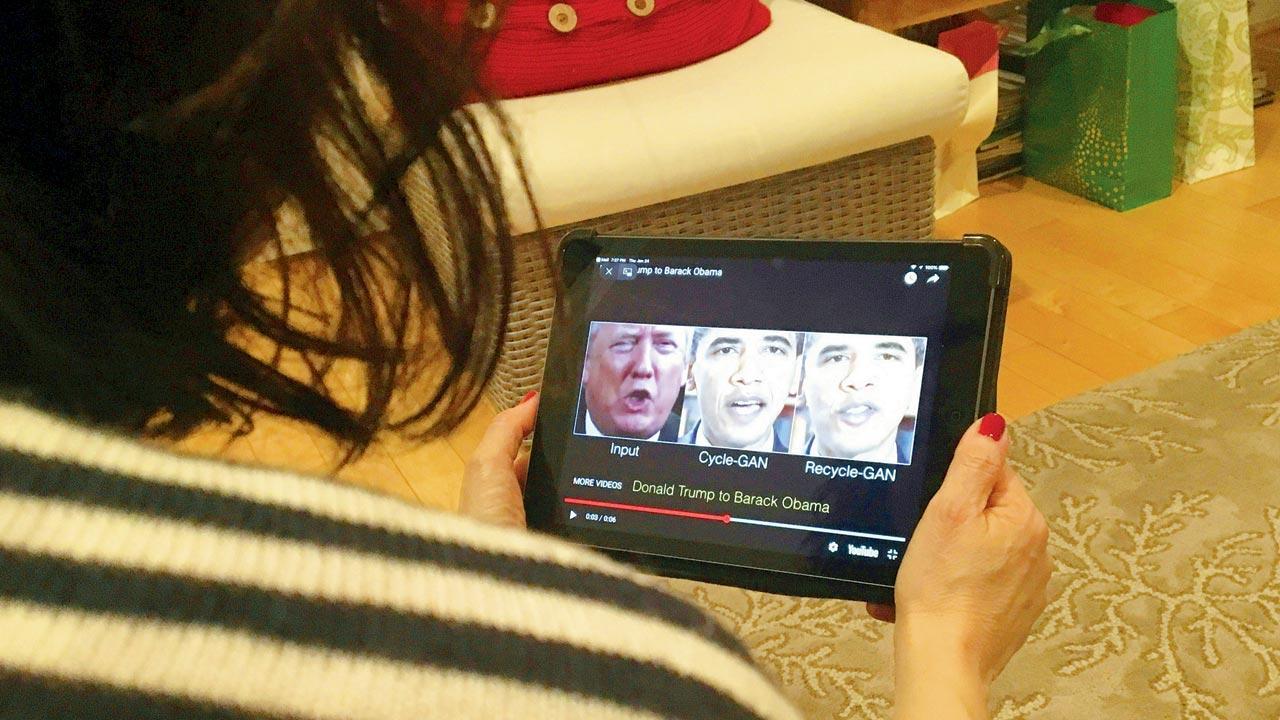
A woman in Washington, DC, views a manipulated video that changes what was said by former presidents Donald Trump and Barack Obama, illustrating how deepfake technology can deceive viewers. Pic/Getty Images
Last year, soon after Queen Elizabeth II delivered her annual Christmas Day speech, a digitally-created fake of the Queen, aired on Channel 4, danced across TV screens and, warned viewers to question “whether what we see and hear is always as it seems”. The video, the broadcaster said, was created as a stark warning about the advanced technology that was enabling the proliferation of misinformation and fake news in a digital age. Again, earlier this year, 10 videos posted between February and June on TikTok, showed actor Tom Cruise doing coin tricks and biting into lollipops among other things. The videos, unsurprisingly, drew millions of views. But they were not of the Hollywood A-lister. They were in fact, created by visual and AI effects artist Chris Umé with the help of a Tom Cruise stand-in. The videos’ popularity inspired Umé to launch the company Metaphysic, which uses the same deepfake technology to make ads and restore old film.
These of course, are examples of advanced deepfakes—the term combining the words “deep learning” and “fake”—created by professionals with the help of voice actors in what is a complicated and expensive process. While the use of such high-quality deepfakes may not pose a widespread threat just yet, as Vladislav Tushkanov, senior data scientist at cybersecurity company Kaspersky tells us, the technology might be used for phishing attacks. Citing an example of the uses his organisation has been tracking for some time, he mentions a recent attack on a company in Great Britain where an executive was phished to transact money to perpetrators when they used a deepfake technology to mimic the voice of one of the officers of the company. “We also saw some deepfake-based phishing videos where an individual claims to be someone else, using the face of a person who is kind of famous to scam people to go on specific websites, pay money, etc.”
Trending Stories
Latest Photos
Latest Videos
Latest Web Stories
ADVERTISEMENT

Ganeshotsav 2026

ADVERTISEMENT