Home / Sunday-mid-day / Article /
The endangered dog
Updated On: 10 July, 2022 07:37 AM IST | Mumbai | Fiona Fernandez
A Bengaluru-based researcher and team are back post-pandemic in the Wayanad forests to estimate the population of the dhole, a wild dog that’s as threatened if not more, as the tiger





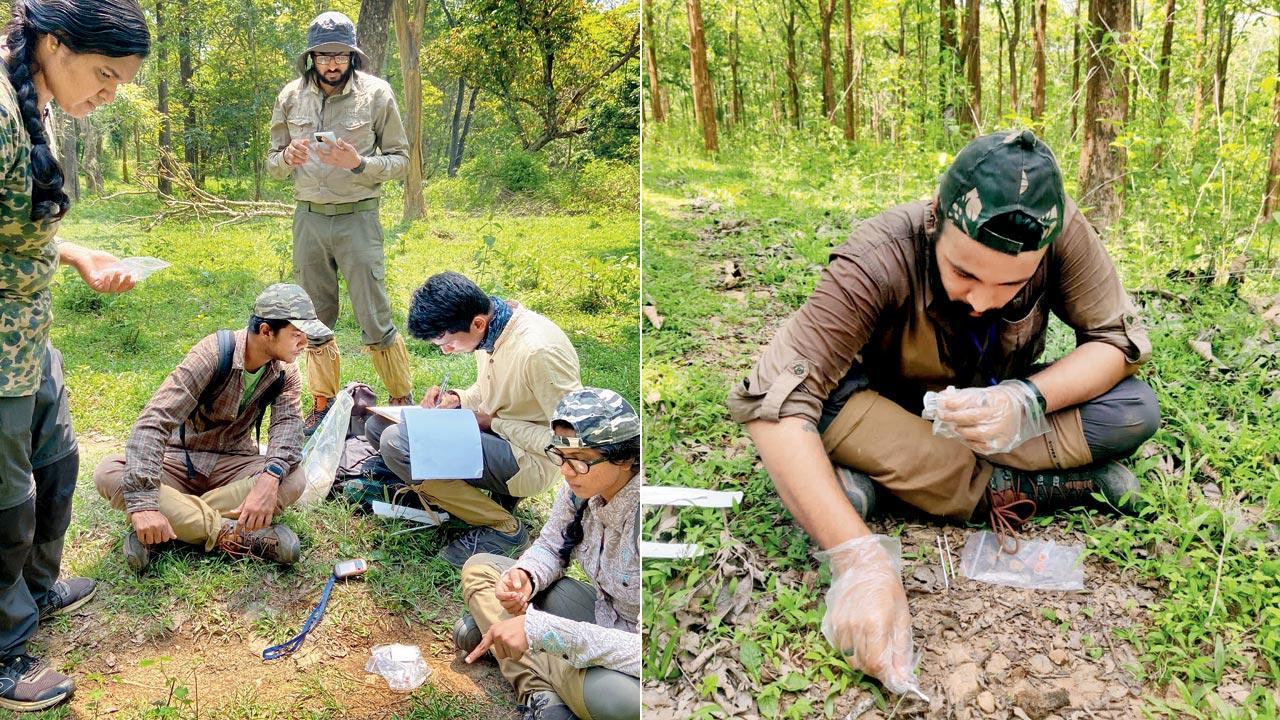
Srivathsa’s team engaged in data collection in Wayanad’s forests; (right) Srivathsa collecting dhole poop. The team looks for faeces samples, extracts the DNA, and ends up with a DNA signature that helps identify the individual animal
Wildlife biologist Arjun Srivathsa is excited that he and his enthusiastic bunch of field researchers and biologists have returned to the forests of Wayanad Sanctuary in Kerala post-pandemic. On an average, they spend close to 10 hours every day, covering hundreds of kilometers to collect genetic information on dholes. This is to identify, and subsequently estimate their population as part of what is perhaps the world’s first multi-year population estimation and monitoring project focussing on wild dogs or dholes.
The project, which began in April 2019, offered the team multiple opportunities to encounter large packs. They found that the area supports a population of 50 dholes at fairly high densities (12-14 per 100 sq km). Carnivore population monitoring must be carried out annually to understand patterns and trends, survival and related aspects of their demography. But, the team’s field work came to an unexpected halt in 2020 following the outbreak of COVID-19.
Trending Stories
Latest Photos
Latest Videos
Latest Web Stories
ADVERTISEMENT

Ganeshotsav 2026

ADVERTISEMENT