Home / Sunday-mid-day / Article /
The grandiosity inside Bombay’s churches
Updated On: 26 September, 2021 08:14 AM IST | Mumbai | Jane Borges
A new book featuring 110 artefacts from Goregaon’s Archdiocesan Heritage Museum hopes to enlighten people about Christian art from the city, which was not only inspired by Indo-Portuguese sensibilities, but also infused elements from other faiths





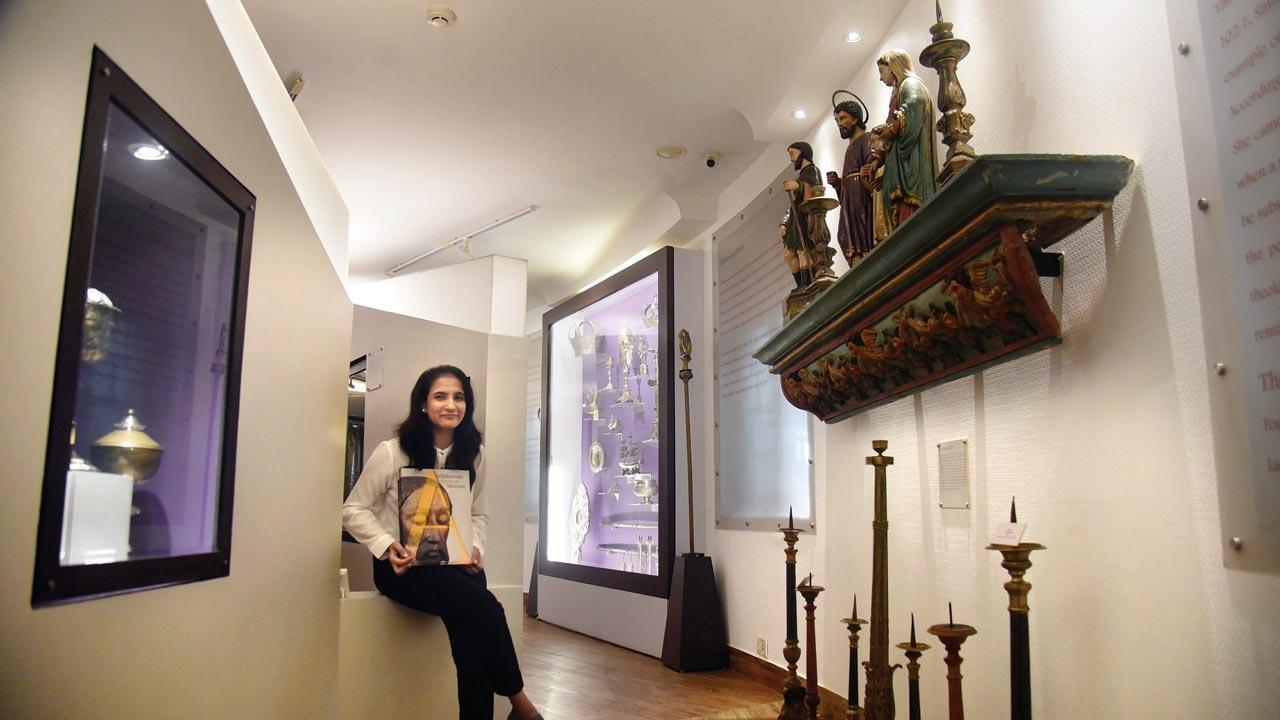
Joynel Fernandes, assistant director, Archdiocesan Heritage Museum, has spent the last six years working on the coffee table book cum catalogue, which shines light on the rare artefacts in the museum’s collection. Pic/Sameer Markande
Not too long after the institution of the Archdiocesan Heritage Museum on the mezzanine of St Pius X College, Diocesan Seminary, Goregaon, its director Fr Warner D’Souza remembers receiving a peculiar request from the Art Gallery of South Australia. This was a couple of years after the museum, the first dedicated to Christian art in Mumbai, came into being in 2011. “At that point in time, the gallery wanted to borrow a couple of our pieces for display. But, they asked, if we had a catalogue to show them [before they could decide],” he recalls. It is then that Fr D’Souza realised that they’d have to “come up to speed,” if they were to work and collaborate with other museums across the world. After a lot of deliberation and discussion with members of the Archdiocesan Heritage Committee (formed in 2006), now called the Committee for the Preservation and Promotion of the Artistic and Historical Patrimony of the Church, they felt that instead of a catalogue, they should publish a book, which would “illuminate people’s minds about Christian art and also talk about processes that went into their creation”.
Nearly eight years on, as part of its 10th anniversary celebrations, the museum has released a coffee table featuring 110 artefacts. “Our collection is extremely vast. So, the pieces we selected [for the book] were those that we felt best represented this collection and would draw interest [in Christian art],” says Fr D’Souza, about the artefacts spanning nearly 400 years and different geographic origins. “We also have ones as recent as the 1960s. The idea was never about having the best and shiniest. We wanted to show beauty even in simplicity. For instance, in the early 1900s, we had zari zardosi work on the vestments, which was not that grand as what was seen in the Portuguese Era. [These find a mention in the book, too].”
Trending Stories
Latest Photos
Latest Videos
Latest Web Stories
ADVERTISEMENT
Mid-Day Fast
ADVERTISEMENT