






Home / Sunday-mid-day / / Article /
How students are learning to preserve specimens and turn it into a skill
Updated On: 25 September, 2022 10:36 AM IST | Mumbai | Mitali Parekh
mid-day spends a morning with six students painstakingly preserving specimens of indigenous or extinct fauna, as they learn to turn this into their specialised skill

Listen to this article :
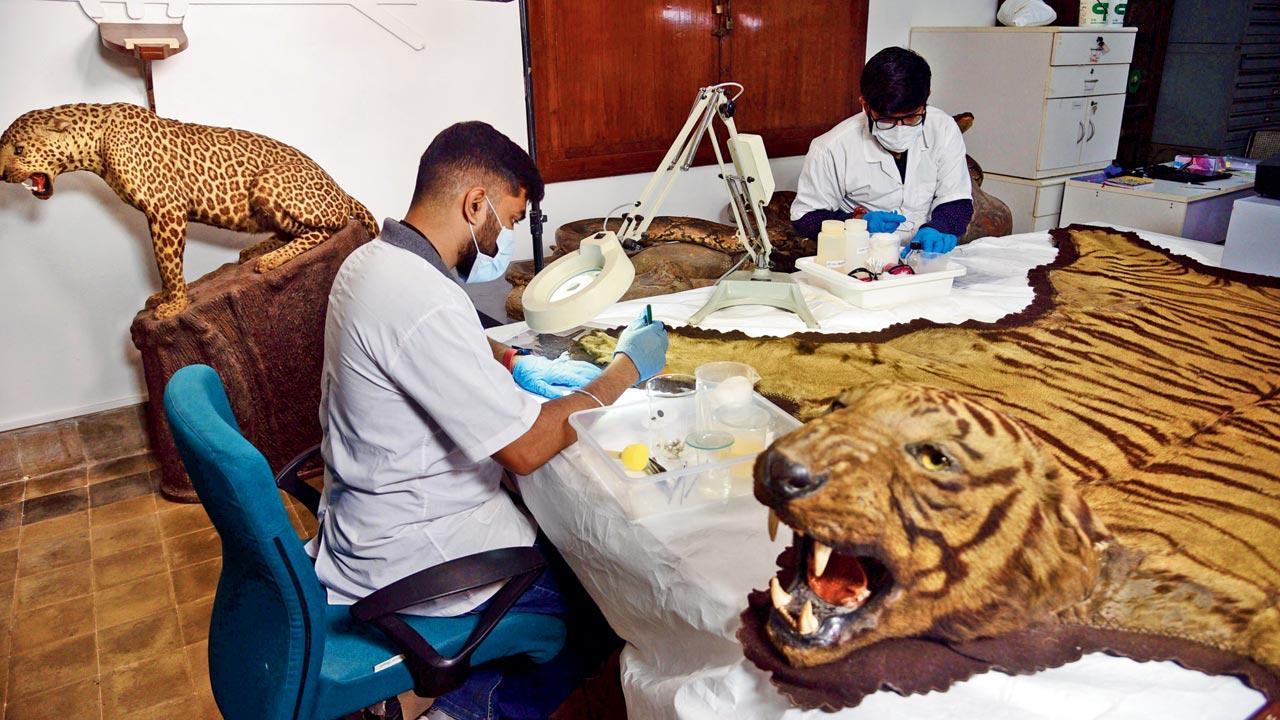
A student, who is part of the three-month course on preservation of natural history specimens at CSMVS, cleans tiger skin that was donated by the Maharani of Dhar in 1922. Pics/Pradeep Dhivar
In one corner, a man in a lab coat is bent over a 10 foot-long tiger skin, concentrating on cleaning a 2-inch by 2-inch patch with slow strokes of a cotton earbud. Behind us, another man is using a dentist’s ultrasonic scaler—usually reserved for chipping away at tartar—on the skull of an Indian bison. It’s the last room reached by the colonnade in the left wing of the Chhatrapati Shivaji Maharaj Vastu Sanghralay (CSMVS).
In the open corridor outside, Ravi Chafe, senior technician, Natural History, CSMVS, is concentrating on what looks like a deflated mucous balloon, splayed and stretched over what could be an overturned kadhai. There’s a sour stink in the air. That is the ocean sunfish—found in such depths that it is too dark to care about looks, and it’s only one of the two specimens found in Maharashtra. The other one is stuffed and part of a diorama in the natural history wing of the museum.
Trending Stories
Latest Photos
Latest Videos
Latest Web Stories
ADVERTISEMENT
Mid-Day Fast
ADVERTISEMENT

ADVERTISEMENT