Home / Sunday-mid-day / Article /
‘Tree planting not same as forest restoration’
Updated On: 20 March, 2023 01:07 PM IST | Mumbai | Prutha Bhosle
India is at second spot in the global tree plantation race. But a Florida University-backed study in Himachal, based on data from 50 years, suggests that ambitious plans to increase carbon storage neither ups forest cover nor supports livelihoods





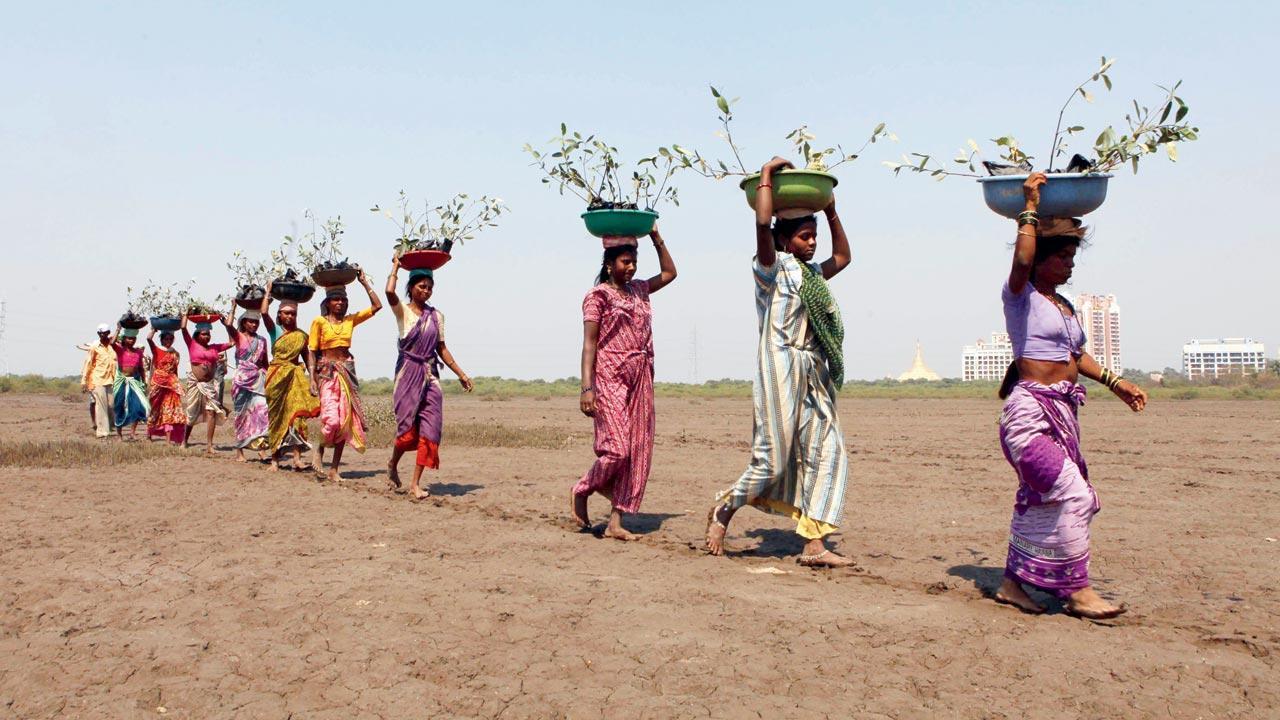
The forest department planted 33,000 mangrove saplings spread over more than 30 hectares of barren land in Charkop village, Kandivli, in March 2013. Pic/Getty Images
The earth is home to over three trillion trees, and India has significantly contributed to this. According to Plant for the Planet’s World Tree Map, India ranks second highest in the world, having planted over 2,159,420,898 trees. But despite this impressive statistic, some researchers and practitioners have raised concerns about potential negative impacts of large-scale tree plantation programmes on vulnerable local people and diverse ecosystems.
A new study—conducted by a team that included researchers from Florida State University, University of Chicago, and the Centre for Ecology Development and Research, Dehradun—has found that large-scale tree plantations may not improve forest cover. The researchers used satellite imagery to study two aspects of the plantations—forest canopy cover and forest composition. The paper titled, Limited effects of tree planting on forest canopy cover and rural livelihoods in Northern India, was published on September 13 in Nature Sustainability. It focuses on plantations done in Himachal Pradesh’s Kangra from 1965 to 2018. Eric Coleman, associate professor of Political Science, Florida State University, and also co-author of the paper, says, “Tree plantations in Kangra do not exhibit significantly greater canopy cover in the years after a planting event. This means that planting trees does not seem to have significantly improved carbon storage. The forest composition has modestly shifted to more needleleaf varieties than broadleaf in the years following planting. This suggests that while the overall canopy cover isn’t changing due to plantations, the types of trees is changing to needleleaf varieties.”
Trending Stories
Latest Photos
Latest Videos
Latest Web Stories
ADVERTISEMENT
Mid-Day Fast
ADVERTISEMENT