Home / Sunday-mid-day / Article /
How this counselling center is making villagers resilient towards climate change
Updated On: 24 April, 2023 09:19 AM IST | Sakhar, Velhe | Jane Borges
Crop yield drop, firewood scarcity, extreme heat and rain are spurring anxiety and depression, finds non-profit working on unique pilot that has thrown open a modern counselling centre to 4,000 residents in Pune district





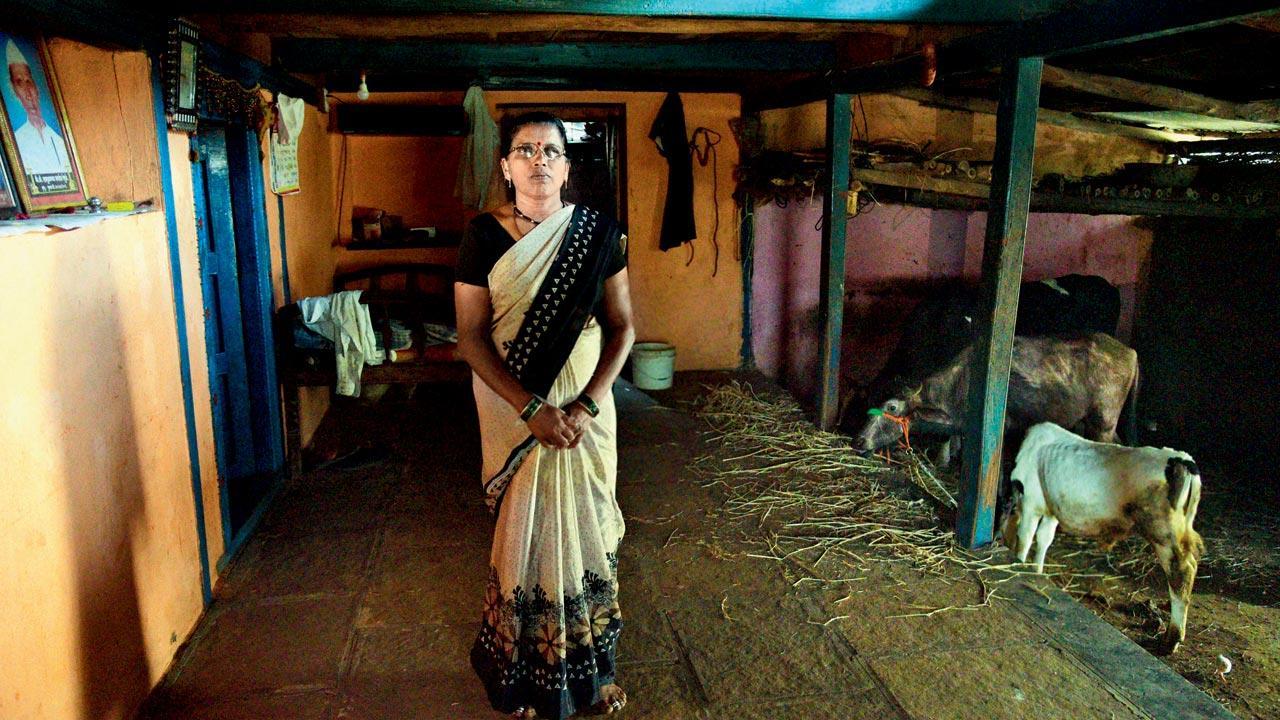
Manda Arjun Renuse is an ASHA worker and resident of Sakhar village in Velhe taluka of Pune district, Maharashtra. She says over the last five months, the free counselling centre set up by Raintree Foundation has become a safe space for women to talk with trained counsellors when they are having a rough day. Pic/Pradeep Dhivar
While Mumbai’s April summer has been ruthless, 210 km away, in the Velhe taluka of Pune district, it is capricious. Burning at 38 degrees Celsius when we arrive on a weekday afternoon, the land looks dead-beat—charred yellow and green. Fifteen hours ago, the taluka was drenched following an unseasonal shower. Tiny puddles on the roadside, now on the verge of drying up, are proof of the previous evening’s downpour. The winding road leading to Rajgad Fort, a 17th century Maratha pride crowning the Sahyadris, breaks at Sakhar village, where our Google Maps stops. Up on a tiny mound, an off-white pakka structure stands like a recluse. Drawing little attention, and hidden by sweeping branches of the trees that line its perimeter, it has become the centre of a slow reform in Velhe.
On November 23 last year, Pune-based non-profit Raintree Foundation set up the Manosaarthi Counselling Centre here. With two counsellors visiting once a week each, on Tuesdays and Saturdays respectively from 9 am to 5 pm, the centre has been catering to a rather reluctant population’s distress and support needs. In the last five months, it has seen 25 villagers, and conducted 89 follow-ups. When we visit, a counselling session is underway. A villager had arrived there an hour earlier, slipping inside the counselling room from a rear entrance. An NGO staff member tells us that this is done to maintain anonymity. “It has taken us a great deal to convince them to come here... we want to respect their privacy.”
Trending Stories
Latest Photos
Latest Videos
Latest Web Stories
ADVERTISEMENT

Ganeshotsav 2026

ADVERTISEMENT