Home / Sunday-mid-day / Article /
What does hate look like on a map? New initiative aims to make people intervene
Updated On: 26 March, 2023 08:49 AM IST | Mumbai | Sucheta Chakraborty
An initiative to chart incidents of violence across the country hopes to rouse citizens to intervene and protect India’s democratic social structure





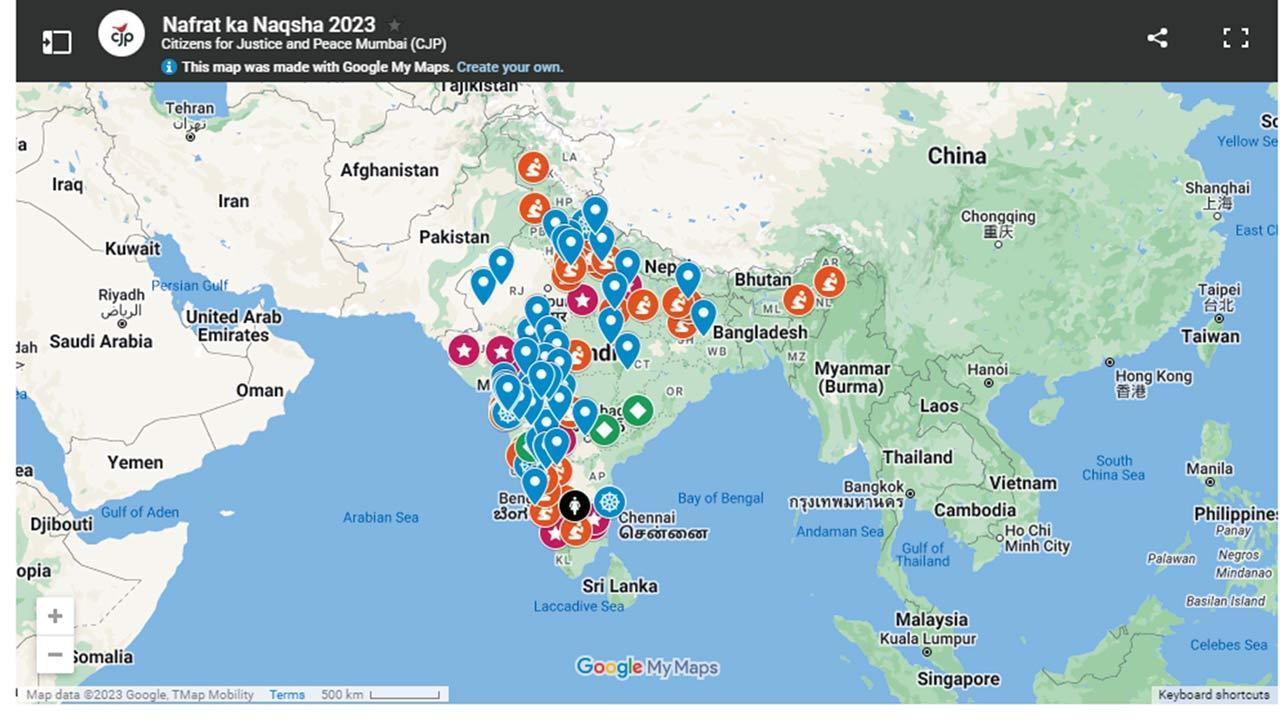
CJP’s Nafrat Ka Naqsha, online since February 2021, has evolved from a prototype Peace Map, a seven-stage conflict management product. It aims to warn, predict and prevent violence across India. Map courtesy/Citizens for Justice and Peace
Hate speech has the characteristic of poisoning the social atmosphere,” Teesta Setalvad tells us over a video call. The civil rights activist—and secretary of the Mumbai-based Citizens for Justice and Peace (CJP)—is talking to us about Nafrat Ka Naqsha, a one-stop hate map to plot incidents of communal, casteist, ethnic conflicts and gender violence in India. This recent addition to the hate tracking activities of the organization—spanning 25 to 30 years—has been on the CJP website since February 2021, With the aim to conscientise citizenry to intervene with the authorities, the map’s objectives are to track, monitor, register pre-emptive complaints with the police, the district collector, the News Broadcasting and Digital Standards Authority (NBDSA), and others, follow up on complaints, and press to file FIRs and prosecute. Citing the 1987 case of Hashimpura-Maliana-Meerut communal violence, Setalvad explains how analysis indicates that three to six months before an upsurge of friction, “hate speech was steadily used by individuals and organisations to ratchet up the public temperature and create an atmosphere of complicity among the wider majority, so that they don’t act to prevent violence, to save lives or to generate a counter-narrative against the stigma of hate.”

Trending Stories
Latest Photos
Latest Videos
Latest Web Stories
ADVERTISEMENT

Ganeshotsav 2026

ADVERTISEMENT